
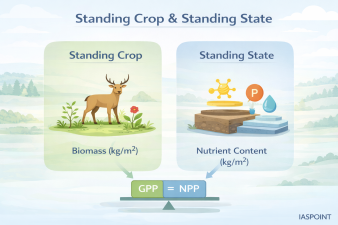
In ecological studies, “Standing Crop” and “Standing State” are two fundamental measurements used to quantify the contents of an ecosystem at a specific point in time. While both describe the “inventory” of an ecosystem, they refer to entirely different components: one biological (biotic) and one chemical (abiotic).
Standing Crop (Biotic Component)
The standing crop represents the total amount of living material present in an ecosystem at a particular time. It is a measure of the biomass stored within the living organisms of a specific trophic level or the entire community.
Key Characteristics
- Nature: It refers exclusively to the living (biotic) matter.
- Measurement: It is expressed as the mass of living organisms (Biomass) per unit area or the number of individuals per unit area.
- Biomass Calculation: Biomass is more accurately measured as Dry Weight rather than fresh weight, as dry weight excludes water content which can fluctuate significantly.
- Functional Role: It indicates the amount of energy currently stored in the living tissue available for the next trophic level.
Standing State (Abiotic Component)
The standing state (also known as the Standing Quality) refers to the total amount of inorganic nutrients present in the abiotic environment (soil, water, or air) of an ecosystem at a given time.
Key Characteristics
- Nature: It refers exclusively to the non-living (abiotic) nutrients.
- Components: It includes essential elements such as Nitrogen (N), Phosphorus (P), Potassium (K), Calcium (Ca), and Carbon (C).
- Dynamics: Unlike the standing crop, the standing state is not “consumed” in a one-way path; these nutrients circulate continuously between the biotic and abiotic components via biogeochemical cycles.
- Variation: The standing state varies across different types of ecosystems and changes seasonally (e.g., nutrient levels in temperate soil differ between summer and winter).
Comparative Summary: Standing Crop vs. Standing State
| Feature | Standing Crop | Standing State |
| Definition | Total living biomass in an ecosystem at a given time. | Total inorganic nutrients in the environment at a given time. |
| Component | Biotic (Plants, Animals, Microbes). | Abiotic (Soil, Water, Air). |
| Examples | Total weight of trees in a forest or fish in a pond. | Amount of Nitrogen, Phosphorus, or Calcium in the soil. |
| Measurement Units | g/m2 or kg/hectare (Biomass). | mg/l or kg/hectare (Nutrient concentration). |
| Primary Process | Governed by Energy Flow. | Governed by Nutrient Cycling. |
Significance for UPSC Prelims
- Productivity Link: The productivity of an ecosystem is often limited by its Standing State. If the soil lacks essential nutrients (low standing state), the rate of biomass production (NPP) will be low, leading to a smaller Standing Crop.
- Trophic Levels: The standing crop is usually highest at the producer level and decreases at each successive trophic level in terrestrial ecosystems.
- Ecological Succession: During the process of ecological succession, both the standing crop (biomass) and the standing state (nutrient retention) generally increase until a climax community is reached.
- Human Impact: Industrial agriculture often artificially inflates the Standing State by adding chemical fertilizers, which temporarily increases the Standing Crop but can lead to long-term soil degradation and water pollution (eutrophication).
Trivia for Aspirants
- Is there a “Standing State” in the atmosphere? Yes. While we often focus on soil, the concentration of CO2 or N2 in the atmosphere at a specific moment is technically part of the global standing state of those elements.
- Fresh vs. Dry Weight: UPSC may test the nuance that Dry Weight is the preferred unit for Standing Crop because it provides a consistent measure of organic matter without the “noise” of varying water levels in organisms.