

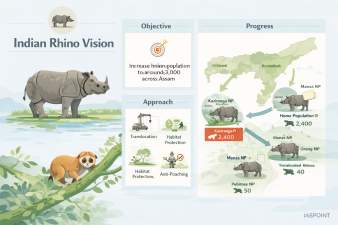
Indian Rhino Vision 2020 was a multi-partner strategic program launched in 2005 to protect and expand the population of the Greater One-horned Rhinoceros (Rhinoceros unicornis) in Assam. The project was a collaborative effort between the Assam Forest Department, the World Wide Fund for Nature (WWF-India), the International Rhino Foundation (IRF), and the U.S. Fish and Wildlife Service.
Core Objectives
The program was designed with the “3000 by 2020” goal, focusing on population growth and geographic distribution.
- Population Target: To increase the total rhino population in Assam to at least 3,000 by the year 2020.
- Range Expansion: To ensure that rhinos are distributed over at least seven protected areas (PAs) in Assam to provide long-term viability.
- Risk Mitigation: By spreading the population across multiple sites, the project aimed to protect the species from localized risks such as massive floods, disease outbreaks, or intensive poaching in a single area (specifically Kaziranga).
The Seven Target Protected Areas
The project identified seven specific habitats in Assam for rhino habitation:
- Kaziranga National Park (Source population)
- Pobitora Wildlife Sanctuary (Source population)
- Manas National Park (Reintroduction site)
- Orang National Park
- Laokhowa Wildlife Sanctuary
- Burachapori Wildlife Sanctuary
- Dibru-Saikhowa National Park
Implementation and Strategy
The primary tool for achieving IRV 2020 was Wild-to-Wild Translocation.
- Translocation Process: Rhinos were captured in Kaziranga and Pobitora (where densities were high) and moved to Manas National Park, which had lost its entire rhino population during civil unrest in the 1990s.
- Radio Collaring: Translocated rhinos were fitted with GPS/GSM radio collars to monitor their movement, adaptation, and security in their new habitats.
- Community Engagement: The project involved local communities through the “Bodo Territorial Council” in Manas to ensure local support for anti-poaching efforts.
Outcome and Current Status
The project officially concluded in April 2021 with the final translocation of two rhinos to Manas National Park.
| Parameter | Result/Observation |
| Population Goal | Achieved. The population surpassed 3,000 in Assam (approx. 4,000+ globally by 2022). |
| Manas Restoration | Success. Manas now has a stable, breeding population of over 50 rhinos. |
| Range Expansion | Partial Success. While populations were strengthened in Manas and Orang, reintroduction in Laokhowa-Burachapori and Dibru-Saikhowa faced delays due to habitat encroachment. |
| Poaching Trends | Significant Decline. Poaching in Assam reached a zero-incident milestone in 2022. |
Major Challenges Faced
- Invasive Species: The growth of Mimosa invisa in the grasslands of Manas and Kaziranga reduced available fodder.
- Human-Wildlife Conflict: Straying rhinos into nearby agricultural fields led to conflicts and retaliatory killings.
- Linear Infrastructure: Roads and railways passing through corridors (e.g., NH-37 near Kaziranga) pose a threat to migrating rhinos during floods.
Way Forward: Rhino Vision 2.0
Building on the lessons of IRV 2020, authorities are now looking toward a second phase.
- Laokhowa-Burachapori Corridor: Efforts are underway to restore the habitat link between Kaziranga and Orang through the Laokhowa and Burachapori sanctuaries.
- Genomic Mapping: Using the RhODIS (Rhino DNA Index System) to build a DNA database for every individual rhino to combat the illegal horn trade.
- Expansion to West Bengal & Bihar: While IRV 2020 was Assam-centric, the national strategy now includes bolstering populations in Jaldapara (West Bengal) and Valmiki (Bihar).
Facts for UPSC Prelims
- First Translocation: The first batch of rhinos was moved from Pobitora to Manas in 2008.
- Key Partners: Remember the Bodoland Territorial Council’s role in the recovery of Manas National Park.
- National Rhino Conservation Strategy: Launched in 2019, it focuses on the conservation of the Greater One-horned Rhino across its entire range in India, not just Assam.
- Ecosystem Services: Rhinos are “mega-herbivores” that help maintain the grassland structure, facilitating the survival of smaller species like the Hog Deer and Hispid Hare.