
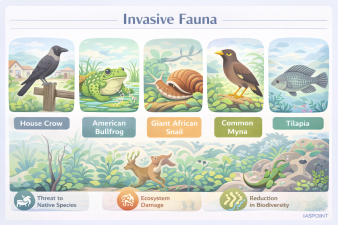
Invasive Alien Species (IAS) are species that are introduced—intentionally or unintentionally—outside their natural biological range and subsequently threaten local ecosystems, biodiversity, and human livelihoods. According to the IPBES (Intergovernmental Science-Policy Platform on Biodiversity and Ecosystem Services), invasive species are one of the five major drivers of global biodiversity loss.
Characteristics of Invasive Fauna
Invasive fauna typically possess specific biological traits that allow them to dominate new environments:
- Rapid Reproduction: High fecundity and short generation times.
- Generalist Feeding: Ability to consume a wide variety of food sources.
- Phenotypic Plasticity: High adaptability to varying environmental conditions.
- Lack of Predators: Absence of natural enemies in the new habitat to control their population.
Major Invasive Fauna in India
India’s diverse ecosystems are under threat from several non-native animal species. The following table summarizes the most significant invasive fauna relevant to the UPSC Prelims:
| Species Name | Origin | Impacted Region | Ecological Impact |
|---|---|---|---|
| African Apple Snail | East Africa | Kerala, Andaman & Nicobar | Damages agricultural crops; carrier of human brain lungworm. |
| Tilapia (Nile Tilapia) | Africa | Inland water bodies across India | Outcompetes native fish like Indian Major Carps for food and space. |
| African Catfish | Africa | Rivers and ponds (Ganga, Yamuna) | Predatory nature; wipes out indigenous fish species; illegal to culture. |
| Common Myna | South Asia (Invasive elsewhere) | Global / Urban India | Aggressive competitor for nesting hollows; displaces native birds. |
| Suckermouth Catfish | South America | Rivers of Bengal, Kerala, and Ganga | Destroys fishing nets; high reproductive rate; lack of local predators. |
| Yellow Crazy Ant | Likely SE Asia | Southern India, Pamban Island | Displaces native ants; secretes formic acid that blinds local fauna. |
| Red-eared Slider | North America | Urban wetlands and rivers | Most popular pet turtle; outcompetes native Indian turtles for basking sites. |
Specific Regional Case Studies
Invasive species often cause localized ecological collapses. Two prominent examples include:
The Spotted Deer (Chital) in the Andamans
Though native to mainland India, the Chital was introduced to the Andaman and Nicobar Islands by the British in the early 20th century. In the absence of natural predators like tigers or leopards, their population exploded. They overgraze the forest floor, preventing the regeneration of native tree species and damaging the unique island flora.
The Gambusia Fish (Mosquitofish)
Introduced globally, including in India, as a biological control agent to eat mosquito larvae. However, it has become a “pest” because it preys on the eggs and larvae of native fish and amphibians, disrupting the aquatic food chain without significantly reducing mosquito populations more effectively than native species.
Legal and Institutional Framework in India
India addresses the threat of invasive species through multiple legislative and international commitments:
- Biological Diversity Act, 2002: Mandates the state to regulate the introduction of alien species and preserve native biodiversity.
- Plant Quarantine (Regulation of Import into India) Order, 2003: Focuses on preventing the entry of pests and invasive flora/fauna through trade.
- Wildlife Protection (Amendment) Act, 2022: Empowers the Central Government to regulate or prohibit the import, trade, and possession of invasive alien species.
- Kunming-Montreal Global Biodiversity Framework (KMGBF): Target 6 specifically aims to reduce the rate of introduction and establishment of invasive alien species by at least 50% by 2030.
Global Conventions and Databases
- Convention on Biological Diversity (CBD): Article 8(h) calls for the prevention and control of invasive species.
- IUCN Invasive Species Specialist Group (ISSG): Maintains the “Global Invasive Species Database” (GISD).
- CITES: Regulates international trade to ensure it doesn’t facilitate the spread of invasive species.
Key Trivia for Prelims
- The “Dirty Dozen”: A term often used for the world’s most invasive species, including the Water Hyacinth (flora) and the Ship Rat.
- Ballast Water Convention: An IMO (International Maritime Organization) treaty aimed at preventing the spread of invasive aquatic organisms carried in ship ballast water.
- Eco-toxicity: Invasive species like the Cane Toad (introduced in Australia, monitored globally) produce toxins that kill native predators, causing a trophic cascade.