
Environmental Impact Assessment (EIA) serves as a bridge between developmental exigencies and ecological imperatives. It is a preventive tool rather than a curative one, ensuring that environmental costs are internalized into the project budget at the inception stage.
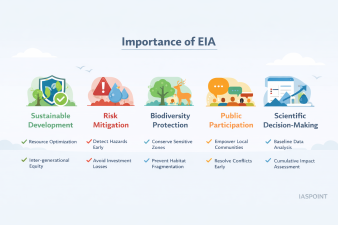
1. Promotion of Sustainable Development
EIA is the primary mechanism to operationalize the “Precautionary Principle” and “Polluter Pays Principle,” which are cornerstones of international environmental law.
- Inter-generational Equity: By assessing the long-term impact on natural resources like groundwater and soil fertility, EIA ensures that the needs of the future generation are not compromised.
- Resource Optimization: It encourages project proponents to explore cleaner technologies and alternative sites that minimize ecological footprints.
2. Risk Mitigation and Cost-Effectiveness
While often perceived as a bureaucratic hurdle, EIA acts as a risk-management tool for developers.
- Early Detection of Hazards: It identifies potential disasters such as chemical leaks, landslides, or floods before construction begins.
- Reduction in Legal Liabilities: Projects that undergo rigorous EIA are less likely to face judicial stay orders or heavy penalties from the National Green Tribunal (NGT) later.
- Avoidance of “Stranded Assets”: By evaluating environmental feasibility, it prevents investment in projects that might eventually be shut down due to ecological non-viability.
3. Protection of Biodiversity and Ecosystem Services
India is a mega-diverse country with several global biodiversity hotspots. EIA provides a specialized lens to protect these areas.
- Conservation of Sensitive Zones: It ensures that projects located near Eco-Sensitive Zones (ESZ), National Parks, and Sanctuaries undergo the highest level of scrutiny.
- Mitigation of Fragmentation: EIA proposes measures like eco-ducts or animal underpasses to ensure that infrastructure projects do not disrupt wildlife migratory corridors.
4. Social Integration and Public Participation
EIA is one of the few statutory processes in India that provides a formal platform for grassroots democracy through Public Hearings.
- Safeguarding Tribal Rights: For projects in Schedule V and VI areas, EIA helps in assessing the impact on the traditional rights and livelihoods of indigenous communities.
- Conflict Resolution: By addressing the concerns of local stakeholders early, it reduces the likelihood of social unrest and local resistance against industrial projects.
- Inclusion of Local Knowledge: Public consultations often bring to light ecological nuances (like seasonal drainage patterns) that technical experts might overlook.
5. Scientific Decision-Making
EIA replaces subjective administrative discretion with objective, data-driven analysis.
- Baseline Data Analysis: It creates a scientific record of the ambient air quality, water levels, and noise levels of a region.
- Cumulative Impact Assessment: Recent trends in EIA focus on the combined impact of multiple projects in a single region (e.g., a series of dams on a single river basin), preventing “death by a thousand cuts.”
Key Facts and Comparative Significance
| Feature | Without EIA | With EIA |
| Approach | Reactive (Damage Control) | Proactive (Prevention) |
| Focus | Economic Profit only | Triple Bottom Line (People, Planet, Profit) |
| Public Role | Excluded | Integral (via Public Consultations) |
| Legal Status | Vulnerable to litigation | Legally resilient if compliant |
Trivia for UPSC Prelims
- United Nations Environment Programme (UNEP): Defines EIA as a tool used to identify the environmental, social, and economic impacts of a project prior to decision-making.
- Article 21: The Supreme Court has held that the Right to a Clean Environment is a part of the Right to Life; EIA is the procedural safeguard for this fundamental right.
- Scope of SIA: Since 2013, Social Impact Assessment (SIA) has become an integral part of land acquisition in India, often running parallel to the EIA process.