
The carbon cycle is the continuous process by which carbon atoms travel from the atmosphere to the Earth and then back into the atmosphere. This cycle maintains a delicate balance that regulates Earth’s temperature; however, human intervention has disrupted this equilibrium, making it the central driver of modern climate change.
Components of the Carbon Cycle
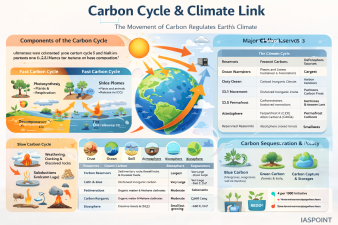
The cycle is divided into “reservoirs” (where carbon is stored) and “fluxes” (the movement between reservoirs).
The Fast Carbon Cycle
This involves the rapid movement of carbon through life forms on Earth and takes place over a lifespan.
- Photosynthesis: Plants and phytoplankton absorb atmospheric CO2 to produce glucose.
- Respiration: Plants and animals release CO2 back into the atmosphere as they consume energy.
- Decomposition: Decomposers break down dead organic matter, releasing carbon into the soil or atmosphere.
The Slow Carbon Cycle
This cycle takes series of millions of years to move carbon through rocks, soil, ocean, and atmosphere.
- Weathering: Rainwater (carbonic acid) dissolves rocks, carrying calcium and bicarbonate ions into the ocean.
- Sedimentation: Marine organisms use these ions to form calcium carbonate shells. When they die, they sink and eventually form limestone.
- Subduction and Volcanism: Tectonic plates carry limestone into the Earth’s mantle, where it melts and is eventually released back as CO2 via volcanic eruptions.
Major Carbon Reservoirs (Sinks)
| Reservoir | Form of Carbon | Relative Size |
| Crust/Lithosphere | Sedimentary rocks (Limestone), Fossil Fuels | Largest (Millions of GtC) |
| Deep Ocean | Dissolved Inorganic Carbon | Very Large (~37,000 GtC) |
| Soil/Permafrost | Organic matter, Methane clathrates | Moderate (~2,500 GtC) |
| Atmosphere | Carbon Dioxide (CO2), Methane (CH4) | Small but growing (~800+ GtC) |
| Terrestrial Biosphere | Living plants and animals | Smallest (~600 GtC) |
The Climate Link: Disrupting the Equilibrium
The link between the carbon cycle and climate change is defined by the Atmospheric Carbon Concentration.
Anthropogenic Perturbation
Since the Industrial Revolution, humans have been extracting carbon from the “Slow Cycle” (Fossil Fuels) and injecting it into the “Fast Cycle” (Atmosphere) at a rate faster than natural sinks can absorb.
- The Revelle Factor: As the ocean absorbs more CO2, its ability to absorb further carbon decreases, leading to a higher fraction of emissions remaining in the atmosphere.
- Deforestation: By removing trees, we reduce the terrestrial “sink” capacity and release stored carbon through “Slash and Burn” practices.
Carbon Feedbacks and Climate Change
- Ocean Warming: Warmer water holds less dissolved CO2 (Henry’s Law). As oceans warm, they may become less efficient at absorbing carbon, or even begin outgassing it.
- Permafrost Feedback: Rising temperatures thaw Arctic permafrost, releasing carbon that has been “locked” out of the cycle for millennia, creating a self-reinforcing warming loop.
Carbon Sequestration and Policy
Natural vs. Artificial Sequestration
- Blue Carbon: Carbon captured by the world’s ocean and coastal ecosystems (Mangroves, Seagrasses, Salt marshes). These ecosystems sequester carbon up to 40 times faster than terrestrial forests.
- Green Carbon: Carbon stored in terrestrial ecosystems like forests and soils.
- Carbon Capture and Storage (CCS): An industrial process where CO2 is captured at the source (power plants) and injected into deep geological formations (saline aquifers or depleted oil fields).
Global Initiatives
- “4 per 1000” Initiative: Launched at COP21, it aims to increase soil organic carbon stocks by 0.4% per year to compensate for global emissions.
- REDD+ (Reducing Emissions from Deforestation and Forest Degradation): A UN-led mechanism that creates a financial value for the carbon stored in forests.
UPSC Trivia: Carbon Fertilization
The Carbon Fertilization Effect refers to the increased rate of photosynthesis in plants that results from increased levels of CO2 in the atmosphere. While this initially sounds positive, the nutritional quality of crops (like wheat and rice) often decreases (lower protein and zinc) under high CO2 conditions, a critical factor for food security in India.
Last Modified: April 20, 2026