
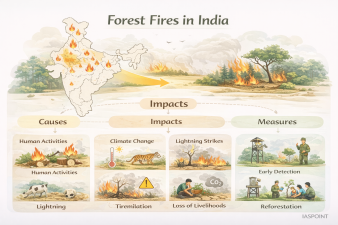
Forest fires are a recurring seasonal phenomenon in India, primarily occurring between November and June, with the peak activity during the dry summer months of March and April. While natural factors like lightning play a role, over 95% of forest fires in India are man-made, stemming from socio-economic and livelihood activities of forest-fringe communities.
Classification and Vulnerability (ISFR 2021 Data)
The Forest Survey of India (FSI) monitors forest fires using satellite data and classifies forest cover based on fire vulnerability. According to the India State of Forest Report (ISFR) 2021, over 35.46% of India’s forest cover is prone to fires.
| Vulnerability Category | Percentage of Forest Cover |
| Extremely Fire Prone | 2.81% |
| Very Highly Fire Prone | 7.85% |
| Highly Fire Prone | 11.51% |
| Total Fire Prone Area | 35.46% |
Geographic Hotspots and Regional Trends
- Top 4 High-Incident States: Odisha, Madhya Pradesh, Chhattisgarh, and Maharashtra account for approximately 43% of all forest fire incidents in India.
- Central India: This region typically reports the highest number of fire alerts due to its vast tracts of Tropical Dry Deciduous Forests, which shed leaves in summer, creating a combustible fuel bed.
- Himalayan Region: Uttarakhand and Himachal Pradesh are highly vulnerable to “Crown Fires” in Chir Pine forests, where the high resin content in pine needles makes the vegetation extremely flammable.
- Northeast India: A significant portion of fire alerts in this region is attributed to Jhum (Shifting) Cultivation practices, particularly in states like Mizoram and Manipur.
Drivers and Causes of Forest Fires
Forest fires in India are largely driven by a combination of traditional practices and climatic changes.
- Shifting Cultivation: The practice of “slash and burn” in hilly terrains often leads to fires escaping into adjacent primary forests.
- NTFP Collection: Local communities often set fire to the forest floor to clear leaf litter, facilitating the collection of Mahua flowers and Tendu leaves.
- Grazing Needs: Small, controlled fires are used to induce the growth of fresh succulent grass for livestock, which can become uncontrolled wildfires.
- Climatic Factors: Prolonged dry spells, rising temperatures, and the accumulation of dry biomass (fuel load) significantly increase the fire danger rating.
- Arson and Poaching: Fires are sometimes intentionally lit by poachers to clear vegetation for better visibility or by timber smugglers to hide evidence of illegal felling.
Monitoring and Institutional Framework
India has moved toward a high-tech, near real-time monitoring system to tackle fire incidents.
- Van Agni Geo-Portal: Developed by the FSI, this portal provides a single-window interface for forest fire alerts and historical data.
- FSI Fire Alert System (FAST 3.0): This system uses satellite sensors (MODIS and SNPP-VIIRS) to detect thermal anomalies. Alerts are disseminated via SMS and email to over 1.6 lakh registered users, reaching down to the “Beat” officer level.
- National Action Plan on Forest Fires (NAPFF), 2018: A comprehensive policy aimed at minimizing fires by informing, enabling, and empowering forest fringe communities and incentivizing them to work with the forest department.
- Financial Support: Funding is primarily routed through the Forest Fire Prevention and Management (FPM) scheme and CAMPA (Compensatory Afforestation Fund Management and Planning Authority) funds.
Technical Facts for UPSC Prelims
- Types of Fires: In India, most fires are Surface Fires (burning leaf litter and small vegetation). Crown Fires (burning tree tops) are rare but occur in coniferous forests of the Himalayas.
- Pre-Fire Alerts: FSI provides “Early Warning Alerts” based on a Forest Fire Danger Rating (FFDR) system which uses parameters like temperature, humidity, and rainfall.
- Impact on Carbon Stock: Forest fires are a major source of Black Carbon and CO2 emissions, potentially turning forest carbon sinks into carbon sources.
- Ecological Role: While destructive, occasional controlled fires are necessary for the regeneration of certain fire-adapted species (like Teak and Sal) by breaking seed dormancy and clearing competing weeds.
Global and National Initiatives
- Global Forest Watch (GFW): Provides global satellite-based data on forest loss and fire alerts.
- One Health Approach: Recognizes the link between forest health, biodiversity loss from fires, and the emergence of zoonotic diseases.
- MISHTI Scheme: While focused on mangroves, it includes protective measures against coastal ecosystem degradation, which indirectly reduces fire risks in saline marshes.