
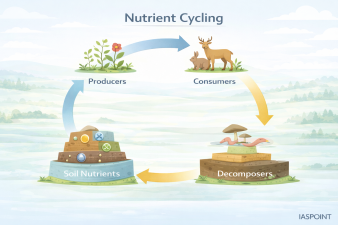
Nutrient Cycling, also known as Biogeochemical Cycles, refers to the continuous movement of nutrients from the physical environment (abiotic) into living organisms (biotic) and their subsequent return to the environment. Unlike energy, which flows unidirectionally and is lost as heat, nutrients are finite and are recycled indefinitely. The “Standing State” of an ecosystem refers to the total amount of these inorganic nutrients (Carbon, Nitrogen, Phosphorus, etc.) present in the soil/environment at any given time.
Classification of Nutrient Cycles
Based on the nature of the reservoir, biogeochemical cycles are divided into two main categories:
| Cycle Type | Primary Reservoir | Nature of Cycle | Examples |
| Gaseous Cycles | Atmosphere or Hydrosphere | Fast and relatively perfect; nutrients are rarely lost for long. | Carbon, Nitrogen, Oxygen, Water |
| Sedimentary Cycles | Earth’s Crust (Lithosphere) | Slow and imperfect; nutrients may get locked in sediments for ages. | Phosphorus, Sulphur, Calcium |
The Carbon Cycle
Carbon is the basic constituent of all organic compounds.
- Sources: Atmospheric CO2, dissolved carbon in oceans (the largest reservoir), and fossil fuels.
- Process: Plants fix CO2 via photosynthesis. It is returned through respiration, decomposition of organic matter, and combustion of biomass or fossil fuels.
- Oceanic Role: Oceans regulate the amount of atmospheric CO2 by acting as a “sink.” Approximately 71% of global carbon is found dissolved in oceans.
The Nitrogen Cycle
Nitrogen is essential for proteins and nucleic acids. Atmospheric Nitrogen (N2) is inert and cannot be used directly by most organisms.
- Nitrogen Fixation: Conversion of N2 to Ammonia (NH3).
- Biological: By bacteria like Rhizobium (symbiotic) and Azotobacter (free-living), or Cyanobacteria (blue-green algae).
- Atmospheric: Through lightning and UV radiation.
- Industrial: Haber-Bosch process for fertilizers.
- Nitrification: Ammonia is converted to Nitrites (NO2^-) by Nitrosomonas and then to Nitrates (NO3^-) by Nitrobacter.
- Assimilation: Plants absorb nitrates to form plant proteins.
- Ammonification: Decomposers break down dead organic matter back into ammonia.
- Denitrification: Bacteria like Pseudomonas and Thiobacillus convert nitrates back into N2 gas, completing the cycle.
The Phosphorus Cycle
Phosphorus is a major constituent of nucleic acids, ATP, and biological membranes. It is a sedimentary cycle.
- Reservoir: Phosphate rocks and fossil bone deposits.
- Process: Weathering of rocks releases phosphates into the soil. Plants absorb them; herbivores get them from plants.
- Return: Through decomposition by phosphatizing bacteria.
- UPSC Fact: Unlike Carbon or Nitrogen, there is no respiratory release of phosphorus into the atmosphere.
The Sulphur Cycle
Sulphur is found in soil, water, and rocks. It has both sedimentary and gaseous characteristics.
- Reservoir: Sedimentary rocks (as Pyrite or Gypsum) and the atmosphere (as SO2 and H2S).
- Release: Weathering of rocks, volcanic eruptions, and decomposition of organic matter release sulphur.
- Human Impact: Burning fossil fuels increases atmospheric SO2, leading to Acid Rain.
Key Concepts for UPSC Prelims
- Perfect vs. Imperfect Cycles: Gaseous cycles are “perfect” because they replace nutrients as fast as they are utilized. Sedimentary cycles are “imperfect” because nutrients can get trapped in deep-sea sediments, making them unavailable for long periods.
- Mineralization: The process where organic matter is decomposed into inorganic minerals by microbes.
- Leaching: The process by which water-soluble inorganic nutrients settle down into the soil horizons and become unavailable as salts.
- Nutrient Pool: The total amount of a nutrient in a specific component (like soil or biomass). The “Labile Pool” is the portion that is actively cycling.
Comparison: Nitrogen vs. Phosphorus Cycle
| Feature | Nitrogen Cycle | Phosphorus Cycle |
| Reservoir | Atmosphere | Lithosphere (Rocks) |
| Gaseous Phase | Present (N2, N2O) | Absent |
| Microbial Role | Critical for all steps | Mainly for decomposition |
| Global Warming | N2O is a potent GHG | No direct impact |