
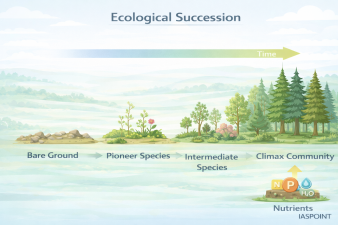
Ecological Succession is the gradual and fairly predictable change in the species composition of a given area over time. It is a directional process where one community is replaced by another until a stable, self-perpetuating community, called the Climax Community, is established. During succession, there is a change in the physical environment (soil, moisture, light) which in turn affects the biotic community. The entire sequence of communities that successively change in a particular area are called Seral Stages or Seres.
Types of Succession
Succession is classified based on the starting conditions of the site and the forces driving the change.
1. Primary Succession
Occurs in a previously lifeless area where no soil exists and no living organisms have ever inhabited the space.
- Sites: Newly cooled lava, bare rock, newly created pond/reservoir.
- Pioneer Species: The first species to invade. On bare rock, these are usually Lichens, which secrete acids to dissolve rock and initiate soil formation.
- Timeframe: Extremely slow (hundreds to thousands of years) because soil formation is a time-consuming process.
2. Secondary Succession
Occurs in areas where a natural community has been destroyed but the soil or sediment remains intact.
- Sites: Abandoned farmlands, burned or cut forests, flooded lands.
- Pioneer Species: Usually grasses or weeds that grow quickly from seeds or roots remaining in the soil.
- Timeframe: Much faster than primary succession as the soil is already present.
| Feature | Primary Succession | Secondary Succession |
| Starting Point | Bare rock/No soil | Existing soil/Organic matter |
| Pioneer Species | Lichens/Mosses | Grasses/Weeds |
| Pace | Very Slow | Relatively Fast |
| Example | Post-volcanic eruption | Post-forest fire |
Classification Based on Habitat
Succession is also categorized by the nature of the environment where it occurs:
- Hydrarch (Hydrosere): Succession that begins in a water body (e.g., a pond). It progresses from hydric (wet) to mesic (moderate moisture) conditions.
- Xerarch (Xerosere): Succession that begins in dry areas (e.g., bare rock/sand). It progresses from xeric (dry) to mesic conditions.
- Lithosere: Succession on bare rock.
- Psammosere: Succession on sand dunes.
Stages of Succession (Mechanism)
The process generally follows five distinct steps:
- Nudation: Formation of a bare area without any life.
- Invasion: Arrival of reproductive bodies (seeds/spores) from other areas.
- Competition and Co-action: Individuals compete for space, light, and nutrients.
- Reaction: The organisms modify their own environment (e.g., lichens turning rock into soil), often making it more suitable for a new set of species and less suitable for themselves.
- Stabilization (Climax): The final stage where the community reaches an equilibrium with the local climate.
Characteristics of a Climax Community
- It is the final, stable stage of succession.
- It is in complete equilibrium with the environmental/climatic conditions of the area.
- It possesses high species diversity and a complex food web.
- Trivia: While seral stages are characterized by high net productivity, the Climax community has high total biomass but lower net productivity because most energy is used for maintenance (respiration).
Key Concepts for UPSC Prelims
- Autogenic Succession: Driven by the biotic components of the ecosystem themselves (e.g., plants changing soil pH).
- Allogenic Succession: Driven by external abiotic factors (e.g., volcanic eruptions, climate change, or forest fires).
- Autotrophic Succession: Dominance of green plants at the start (common in most successions).
- Heterotrophic Succession: Dominance of heterotrophs like bacteria and fungi (occurs in environments rich in organic matter, like a fallen log).
Ecological Trends during Succession
As succession progresses toward a climax community, the following trends are observed:
- Species Diversity: Increases from pioneer to climax.
- Niche Specialization: Becomes more narrow and specific.
- Biomass: Total organic matter increases.
- Nutrient Cycling: Becomes more “closed” and efficient.
- Humus Content: Soil organic matter and depth increase significantly.