
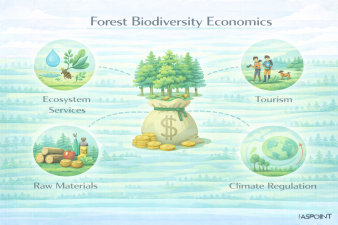
Forest Biodiversity Economics is an evolving field that bridges the gap between ecological preservation and economic growth.
Conceptual Foundation: Valuing Natural Capital
Forests are no longer viewed merely as sources of timber but as “Natural Capital.” The economics of forest biodiversity focuses on the trade-off between the immediate gains from deforestation and the long-term economic loss of ecosystem services.
The Dasgupta Review (2021)
The landmark Dasgupta Review on the Economics of Biodiversity highlighted that humanity’s demands on nature far exceed its sustainable supply. Key takeaways include:
- Natural Capital as an Asset: Biodiversity is a portfolio of assets that provides “dividends” like carbon sequestration, water purification, and pollination.
- Inclusive Wealth: Traditional GDP is an insufficient measure of progress because it does not account for the depreciation of natural assets.
- Standard of Measure: The review advocates for a shift from GDP to “Inclusive Wealth,” which includes produced, human, and natural capital.
TEEB: The Economics of Ecosystems and Biodiversity
Launched by Germany and the European Commission (led by Pavan Sukhdev), TEEB is a global initiative to make the values of nature visible.
Key Pillars of TEEB
- Recognizing Value: Identifying the wide range of benefits provided by ecosystems (e.g., spiritual, cultural, and ecological).
- Demonstrating Value: Using economic tools to quantify the costs of biodiversity loss.
- Capturing Value: Implementing policy mechanisms like Payments for Ecosystem Services (PES) to reward conservation.
Ecosystem Services Classification
Forests provide four primary types of services that form the basis of their economic valuation:
| Category | Description | Examples |
| Provisioning | Products obtained directly from forests. | Timber, NTFP (Non-Timber Forest Products), medicinal plants, fodder. |
| Regulating | Benefits from the regulation of ecosystem processes. | Carbon sequestration, flood control, pollination, water purification. |
| Cultural | Non-material benefits that enrich human life. | Ecotourism, spiritual value, aesthetic inspiration. |
| Supporting | Services necessary for the production of all other services. | Nutrient cycling, soil formation, primary production. |
Green Accounting and Green GDP in India
Green GDP is an index of economic growth that subtracts the cost of environmental degradation and resource depletion from the conventional GDP.
Status in India
- RBI Estimates (2022): The Reserve Bank of India estimated India’s Green GDP at approximately ₹167 trillion in 2019, reflecting the significant impact of environmental factors on the economy.
- Natural Capital Accounting and Valuation of Ecosystem Services (NCAVES): India is one of five countries (along with Brazil, China, Mexico, and South Africa) participating in this UN-backed project to mainstream environmental accounting.
- Ministry of Statistics and Programme Implementation (MoSPI): MoSPI releases the EnviStats India report annually, which provides physical and monetary accounts of India’s natural assets.
Carbon Markets and Forest Economics
The transition to a low-carbon economy relies heavily on forest-based mitigation.
Carbon Credit Trading Scheme (CCTS), 2023
India has notified the CCTS to develop a domestic carbon market.
- Sequestration Activities: Reforestation and agroforestry projects generate “carbon credits” which can be sold to entities exceeding their emission limits.
- Status: As of 2026, India remains a global leader in the voluntary carbon market (VCM), though domestic trade is still in its nascent stages under the new GEI (Greenhouse Gas Emission Intensity) Rules.
Legal and Policy Frameworks
Recent legislative changes in India have direct implications for the economics of forest biodiversity.
Forest (Conservation) Amendment Act, 2023
- Strategic Exemptions: Exempts forest land within 100 km of international borders for national security projects.
- Commercialization: Explicitly allows for activities like zoos, safaris, and ecotourism within forest areas to boost local economies.
- Critique: Environmentalists argue this may prioritize commercial “Compensatory Afforestation” over the preservation of complex, native old-growth forests.
Green Credit Programme (GCP)
A market-based mechanism launched to incentivize voluntary environmental actions. Unlike carbon credits, Green Credits can be earned for a variety of activities, including water conservation and waste management, and are tradable on a dedicated exchange.
Important Facts and Trivia for Prelims
- Pavan Sukhdev: An Indian environmental economist who headed the TEEB study; often cited in questions regarding the valuation of nature.
- 1.6 Earths: The estimate provided by the Dasgupta Review for the number of planets needed to sustain current human consumption patterns.
- Net Present Value (NPV): A mandatory fee paid by project proponents for diverting forest land for non-forest use in India, intended to reflect the lost value of the forest.
- MISHTI Scheme: Mangrove Initiative for Shoreline Habitats & Tangible Incomes, focusing on the economic and ecological restoration of mangroves.
- Green Credit vs. Carbon Credit: Carbon credits focus strictly on CO2 emissions; Green Credits are broader, covering biodiversity, water, and soil health.