

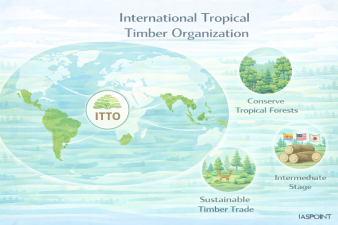
The International Tropical Timber Organization (ITTO) is an intergovernmental organization that promotes the sustainable management and conservation of tropical forests. It facilitates the expansion and diversification of international trade in tropical timber from sustainably managed and legally harvested forests.
Establishment and Mandate
- Founded: 1986 under the auspices of the United Nations.
- Legal Basis: It operates under the International Tropical Timber Agreement (ITTA). The current governing treaty is the ITTA, 2006, which entered into force in 2011.
- Headquarters: Yokohama, Japan.
- Relationship with UN: Unlike many other commodity organizations, ITTO was established under the United Nations Conference on Trade and Development (UNCTAD) but functions as an independent entity.
Membership and Structure
ITTO members represent about 80% of the world’s tropical forests and 90% of the global trade in tropical timber.
- Categorization: Members are divided into two distinct groups:
- Producer Members: Tropical countries with significant forest resources (e.g., India, Brazil, Indonesia).
- Consumer Members: Countries that are net importers of tropical timber (e.g., USA, EU-27, China, Japan).
- India’s Status: India is a founder member and belongs to the Producer Member category.
- Governing Body: The International Tropical Timber Council (ITTC) is the highest authority and meets annually to approve projects and develop forest policies.
Core Objectives and Functions
The organization balances the twin goals of trade and conservation:
- Sustainable Forest Management (SFM): Develops internationally agreed-upon policy guidelines to encourage SFM and sustainable tropical timber industries.
- Market Transparency: Collects, analyzes, and disseminates data on the production and trade of tropical timber (Market Intelligence).
- Project Funding: Has funded more than 1,200 projects focusing on forest restoration, wood-use efficiency, and community-level industrial development.
- Capacity Building: Assists member countries in strengthening forest law enforcement and governance (FLEG) to address illegal logging.
Key Features of ITTA, 2006
The 2006 Agreement introduced several modern environmental mandates that were absent in the original 1983 agreement:
- Poverty Alleviation: Explicitly links sustainable timber trade to the socio-economic well-being of forest-dependent communities.
- Non-Timber Forest Products (NTFPs): Recognizes the importance of environmental services and NTFPs in the sustainable management of forests.
- The Bali Partnership Fund: A dedicated fund established to assist producer members in making investments necessary to achieve the “ITTO Objective 2000” (ensuring exports come from sustainable sources).
Comparison of ITTO vs. Other Forest Initiatives
| Feature | ITTO | UN-REDD / REDD+ |
| Primary Focus | Sustainable Timber Trade & Management | Carbon Sequestration & Emission Reduction |
| Scope | Tropical Forests Only | All Forest Types |
| Mechanism | Commodity-based (Timber) | Incentive-based (Carbon Credits) |
| Governance | ITT Council (Producers & Consumers) | UNFCCC Framework |
Important Facts for Prelims
- Objective 2000: An ITTO commitment that all tropical timber traded by its members should be sourced from sustainably managed forests.
- Definition of Tropical Timber: Under ITTA, it specifically refers to non-coniferous tropical wood for industrial uses (logs, sawnwood, veneer, and plywood) grown between the Tropic of Cancer and the Tropic of Capricorn.
- Collaborative Partnership on Forests (CPF): ITTO is a key member of this inter-agency partnership, which includes the FAO, UNEP, and the World Bank.
- Recent Developments: In 2024, ITTO received accreditation as an international access entity for the Green Climate Fund (GCF), allowing it to propose large-scale forest landscape restoration programs.