

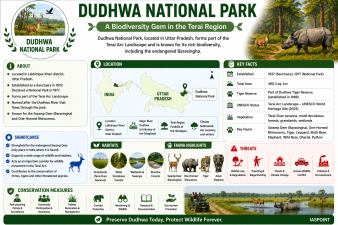
Dudhwa National Park is situated in the Lakhimpur Kheri district of Uttar Pradesh, bordering Nepal.
- Establishment: Declared a Wildlife Sanctuary in 1958 (specifically for Swamp Deer) and elevated to a National Park in 1977.
- Dudhwa Tiger Reserve: In 1987-88, the park was merged with Kishanpur Wildlife Sanctuary and Katarniaghat Wildlife Sanctuary to form the Dudhwa Tiger Reserve.
- Transboundary Link: It forms a critical part of the Terai Arc Landscape (TAL), providing a transboundary corridor for wildlife moving between India and Nepal’s Shuklaphanta National Park.
Ecological Landscape and Flora
The park is characterized by a mosaic of dense forests, vast alluvial grasslands, and perennial wetlands (locally known as tals).
- Forest Type: Dominated by Tropical Moist Deciduous forests. It contains some of the finest Sal forests (Shorea robusta) in India.
- Grasslands: Known as “Phantas,” these extensive marshes and grasslands are essential for the survival of obligate grassland species.
- Hydrology: The park is fed by the Suheli and Mohana rivers, which create a network of streams and lakes critical for the swampy terrain.
Key Fauna and Conservation Success
Dudhwa is the only place in Uttar Pradesh that hosts both the Tiger and the One-horned Rhinoceros.
| Species | Significance |
| Swamp Deer (Barasingha) | Half of the world’s population of the “Northern” subspecies is found here. |
| Royal Bengal Tiger | A flagship species of the Dudhwa Tiger Reserve. |
| Great Indian One-horned Rhino | Successfully reintroduced in 1984 from Assam and Nepal. |
| Hispid Hare | An extremely rare and elusive lagomorph thought to be extinct until rediscovered here. |
| Bengal Florican | A critically endangered bustard species that depends on the park’s grasslands. |
Rhino Reintroduction Program
Dudhwa is famous for one of India’s most successful species reintroduction experiments.
- Phase I (1984): Rhinos were translocated from Pobitara (Assam) and Chitwan (Nepal) to a fenced area called the Rhino Rehabilitation Area (RRA).
- Status: The population has grown significantly, leading to the creation of a second RRA within the park to prevent overgrazing and inbreeding.
Cultural and Human Element: The Tharu Tribe
The fringe areas of Dudhwa are inhabited by the Tharu tribe.
- Socio-Cultural Link: The Tharus have lived in harmony with the Terai forests for centuries.
- Ecotourism: They are actively involved in the park’s management and ecotourism initiatives, showcasing indigenous knowledge and sustainable living.
Key Trivia for UPSC Prelims
- Billy Arjan Singh: The legendary conservationist played a pivotal role in the establishment of the park and is famous for his efforts to protect tigers and leopards (including the famous leopardess ‘Tara’).
- Northern Swamp Deer: Unlike the Hard-ground Barasingha of Kanha (MP), the Dudhwa subspecies is adapted to the marshy Terai tracts.
- Katarniaghat Link: This sanctuary, part of the reserve, is famous for its population of Gharials and Gangetic Dolphins in the Girwa River.
- Threatened Avifauna: Dudhwa is a stronghold for the Sarun Crane (the state bird of UP) and the Great Slaty Woodpecker.
Management and Threats
- Human-Wildlife Conflict: Due to the proximity of sugarcane cultivation to the park boundaries, “sugarcane tigers” (tigers living in fields) often lead to conflicts.
- Linear Infrastructure: Railway tracks passing through the core area have historically been a cause of wildlife mortality.
- Invasive Species: The encroachment of woody perennials into the phantas (grasslands) requires active management to maintain the habitat for Barasingha.