

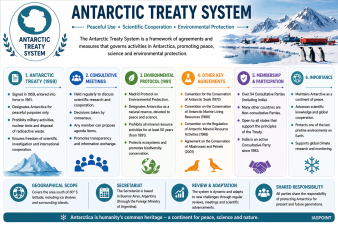
The Antarctic Treaty System is the complex of arrangements made for the purpose of regulating relations among states in the Antarctic. It is a unique global agreement that sets aside a whole continent as a scientific preserve, establishing freedom of scientific investigation and banning military activity.
- Effective Date: Signed on December 1, 1959; entered into force on June 23, 1961.
- Geographical Scope: Applies to the area south of 60° South Latitude, including all ice shelves and islands.
- Current Status (2026): There are 58 parties to the treaty.
- Secretariat: Located in Buenos Aires, Argentina.
Core Pillars of the Antarctic Treaty
The 1959 Treaty contains 14 articles that establish the legal framework for the continent.
- Peaceful Use: Antarctica shall be used for peaceful purposes only. Military bases, maneuvers, and weapon testing are strictly prohibited (Article I).
- Scientific Cooperation: Promotes international cooperation and the free exchange of scientific observations and results (Articles II & III).
- Freeze on Territorial Claims: The treaty does not recognize, dispute, or establish territorial sovereignty claims. No new claims shall be asserted while the treaty is in force (Article IV).
- Nuclear-Free Zone: Any nuclear explosions and the disposal of radioactive waste in Antarctica are prohibited (Article V).
- Inspection System: All areas, including stations and equipment, are open to inspection at any time by designated observers from consultative parties (Article VII).
Components of the Treaty System
The ATS has expanded through several additional legal instruments to address environmental and resource management.
| Agreement | Year | Key Objective |
| The Antarctic Treaty | 1959 | Basic framework for peace and science. |
| CCAS | 1972 | Convention for the Conservation of Antarctic Seals. |
| CCAMLR | 1980 | Convention on the Conservation of Antarctic Marine Living Resources; manages the krill fishery and marine ecosystem. |
| Madrid Protocol | 1991 | Protocol on Environmental Protection; designates Antarctica as a “natural reserve.” |
The Madrid Protocol (1991)
This protocol is the most significant addition to the ATS, prioritizing the environment.
- Mining Ban: Article 7 prohibits all activities relating to mineral resources, except for scientific research. This ban is indefinite.
- Environmental Impact Assessment (EIA): Mandatory for all activities, including tourism and governmental programs.
- Committee for Environmental Protection (CEP): Established to provide advice and recommendations to the Treaty parties.
India and the Antarctic: Legal and Research Status
India has been a prominent player in Antarctic governance since the early 1980s.
- Accession: India signed the Antarctic Treaty in 1983 and received Consultative Status (voting rights) the same year.
- Nodal Agency: The National Centre for Polar and Ocean Research (NCPOR), Goa, under the Ministry of Earth Sciences.
The Indian Antarctic Act, 2022
India enacted its first domestic legislation to fulfill its obligations under the ATS and the Madrid Protocol.
- Jurisdiction: Extends the application of Indian laws and the jurisdiction of Indian courts to crimes committed in Antarctica by Indian citizens or those part of Indian expeditions.
- Permit System: Requires a permit for any Indian expedition or individual to enter or stay in Antarctica.
- Strict Prohibitions: Bans mining, dredging, and activities harming native flora/fauna. It also prohibits the discharge of waste or pollutants.
- Penalties: Includes heavy fines (up to ₹50 crore) and imprisonment for serious violations like dumping nuclear waste or unauthorized mining.
Indian Research Stations in Antarctica
India has established three permanent research stations, of which two are currently operational.
- Dakshin Gangotri (1983): India’s first station; now abandoned and submerged in ice, used only as a supply base.
- Maitri (1989): Located in the Schirmacher Oasis. It is a year-round station.
- Bharati (2012): Located in Larsemann Hills. It is a state-of-the-art green station built with 134 recycled shipping containers.
- Maitri-II (Planned): In 2025-2026, the government accelerated plans to replace the aging Maitri station with Maitri-II, expected to be operational by 2030-2032 to enhance research in glaciology and climate studies.
Essential Trivia for Prelims
- Two-Tier Membership:
- Consultative Parties: 29 nations (including India) that carry out substantial research and have voting rights.
- Non-Consultative Parties: 29 nations that have ratified the treaty but do not participate in decision-making.
- Claimant Nations: Seven countries (Argentina, Australia, Chile, France, New Zealand, Norway, UK) have historical territorial claims, which are “frozen” by the treaty.
- Consensus Rule: All decisions at the Antarctic Treaty Consultative Meetings (ATCM) must be made by consensus among consultative parties.
- Pole of Inaccessibility: The point on Antarctica furthest from any ocean, where the former Soviet Union established a station.