
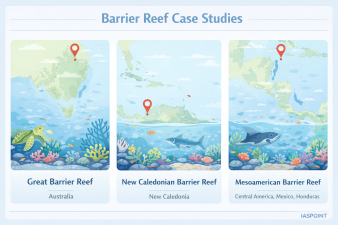
A barrier reef is a coral reef that runs parallel to the shore but is separated from it by a wide, deep lagoon. These are the most massive reef structures globally and serve as critical coastal defense systems.
Case Study 1: The Great Barrier Reef (Australia)
The largest living structure on Earth, stretching over 2,300 km off the coast of Queensland in the Coral Sea.
Recent Developments (2024–2026)
- Mass Bleaching Crisis: In April 2024, NOAA and the Great Barrier Reef Marine Park Authority (GBRMPA) confirmed the Fourth Global Bleaching Event. Aerial surveys in 2024-25 revealed that nearly 80% of the reef was impacted by heat stress.
- Climate Resilience Strategy (2025): Australia launched a updated reef protection plan focusing on Crown-of-Thorns Starfish (COTS) control and sediment reduction from the Burdekin and Fitzroy river basins.
- UNESCO Status: As of 2026, the reef remains a World Heritage Site, though “In Danger” listings are frequently debated due to persistent marine heatwaves and cyclone damage (e.g., Cyclone Jasper in late 2023).
Case Study 2: Belize Barrier Reef Reserve System (Belize)
The largest barrier reef in the Northern and Western Hemispheres and the second-largest in the world.
Conservation Highlights
- Blue Bonds for Ocean Conservation: In a landmark financial move, Belize restructured its national debt to fund the permanent protection of its marine environment, including the reef.
- Mangrove Integration: Unlike many other reefs, the Belize system is deeply interconnected with dense mangrove forests and offshore atolls like the Great Blue Hole.
- Offshore Drilling Ban: Belize is one of the few nations to have a permanent moratorium on offshore oil exploration to protect the reef’s integrity.
- UNESCO Status: It was removed from the “List of World Heritage in Danger” in 2018 following the drilling ban, serving as a global success story for conservation.
Case Study 3: New Caledonia Barrier Reef (France/Pacific)
The world’s second-longest double barrier reef and the largest lagoon in the world (24,000 sq. km).
Key Characteristics
- Double Barrier System: It features a unique “reef within a reef” structure, providing diverse habitats from mangroves to deep oceanic gradients.
- Endemism: It boasts a higher concentration of reef structures (146 types) and higher fish diversity per unit area than the Great Barrier Reef.
- Dugong Habitat: Home to the world’s third-largest population of Dugongs (Sea Cows).
- Threats: Sedimentation from Nickel Mining on the main island (Grande Terre) is a unique anthropogenic threat specific to this region.
Comparative Analysis for Prelims
| Feature | Great Barrier Reef | Belize Barrier Reef | New Caledonia Reef |
| Location | Coral Sea, Australia | Caribbean Sea, Belize | South Pacific, New Caledonia |
| Rank (Size) | 1st Largest | 2nd Largest (Western Hem.) | 2nd Longest (Double Reef) |
| Unique Highlight | Visible from space | Includes the Great Blue Hole | Highest diversity of reef types |
| Primary Threat | Marine Heatwaves/El Niño | Coastal Development/Tourism | Nickel Mining Sedimentation |
| Management | GBRMPA (Statutory Body) | Blue Bond Financing | Co-management with Kanak people |
Global Conservation “In-Danger” Metrics
UNESCO evaluates these sites based on “Outstanding Universal Value” (OUV).
- The 30×30 Target: Most barrier reef nations have committed to the Kunming-Montreal Global Biodiversity Framework to protect 30% of marine areas by 2030.
- The Mangrove Breakthrough: A 2023-2026 global push to secure $4 billion for mangroves, which act as a filter for barrier reefs by trapping land-based silt.