

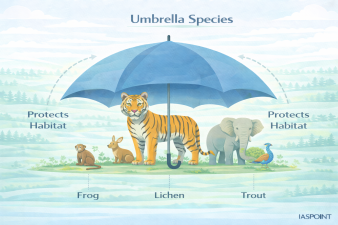
An Umbrella Species is a species selected for conservation because protecting it indirectly protects many other species that make up the ecological community of its habitat. These species typically have large habitat requirements, so their conservation necessitates the protection of vast, high-quality landscapes.
Core Logic of the Umbrella Effect
The “umbrella” metaphor refers to the fact that the species’ wide geographical range and complex habitat needs “cover” the requirements of numerous smaller, less charismatic, or less mobile species. By securing the habitat for one large species, we automatically conserve the entire ecosystem and its biodiversity.
Criteria for Selection
For a species to be an effective umbrella, it must satisfy specific ecological criteria:
- Large Home Range: The species requires a large area to find food, mates, and territory (e.g., migratory corridors).
- Habitat Complexity: It must inhabit a variety of niche environments within its range.
- Sensitivity to Human Disturbance: Umbrella species are often the first to disappear when a habitat is degraded.
- Co-occurrence: Many other species of conservation concern must share the same geographic space.
Comparative Analysis: Umbrella vs. Other Categories
| Category | Primary Objective | Example |
| Umbrella Species | Habitat-wide protection for all co-habitants. | Tiger (Project Tiger). |
| Flagship Species | Public appeal and fundraising (Symbolic). | Giant Panda, Red Panda. |
| Keystone Species | Maintaining ecosystem function/balance. | Sea Otter, Wolf. |
| Indicator Species | Monitoring environmental health/pollution. | Lichens, Frogs. |
Key Examples of Umbrella Species
1. The Tiger (India)
The Tiger is arguably the most significant umbrella species in the Indian context.
- Protection Mechanism: Under Project Tiger, the creation of Tiger Reserves involves protecting vast tracts of forest.
- Umbrella Effect: Protecting a Tiger’s territory ensures the survival of herbivores (Chital, Sambar), smaller carnivores (Leopards, Dholes), soil microorganisms, and various bird and plant species within that forest.
2. The African Elephant
Elephants travel across huge landscapes and multiple types of vegetation.
- Protection Mechanism: Conserving elephant corridors prevents habitat fragmentation.
- Umbrella Effect: Their protection ensures that smaller mammals, insects, and specific plant species that rely on elephant-dispersed seeds or elephant-created clearings also thrive.
3. Northern Spotted Owl (USA)
A classic example from the Pacific Northwest.
- Protection Mechanism: To protect the owl, large areas of old-growth forests were preserved from logging.
- Umbrella Effect: This protected the entire old-growth ecosystem, including mollusks, salamanders, and rare fungi that would have perished if the forest were cleared.
Advantages and Limitations
Advantages
- Strategic Efficiency: It is easier and more cost-effective to manage one species than hundreds of individual species.
- Landscape Connectivity: It promotes the creation of large-scale corridors and prevents “island” ecosystems.
- Policy Synergy: Umbrella species are often “Flagship” species as well, making it easier to gain political and public support for large-scale land protection.
Limitations
- The “Charismatic Bias”: Smaller, non-overlapping ecosystems (like rare specialized bogs or caves) might be ignored because they don’t host a large umbrella species.
- Mismatched Needs: The specific habitat requirements of the umbrella species might not perfectly cover the needs of every single rare species in the area.
UPSC Prelims Trivia: The “Charismatic Megafauna”
Most umbrella species belong to the category of Charismatic Megafauna—large animal species with widespread popular appeal. While conservationists use them as umbrellas for ecological reasons, their “charismatic” nature is leveraged to secure the massive funding required for large-scale habitat management.
Significance in Indian Conservation
In India, the National Board for Wildlife (NBWL) and the National Tiger Conservation Authority (NTCA) frequently utilize the umbrella species concept to demarcate Eco-Sensitive Zones (ESZ) and Protected Areas, ensuring that “Project Tiger” or “Project Elephant” acts as a shield for the entire regional biodiversity.
Last Modified: April 18, 2026