

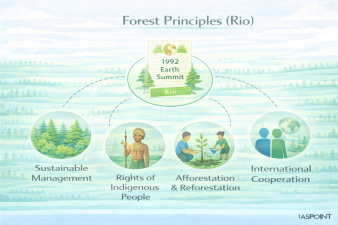
The Forest Principles, formally known as the “Non-Legally Binding Authoritative Statement of Principles for a Global Consensus on the Management, Conservation and Sustainable Development of All Types of Forests,” were adopted during the 1992 United Nations Conference on Environment and Development (UNCED), also known as the Rio Earth Summit.
Context and Significance
- Nature: It is a “soft law” instrument, meaning it is not legally binding but carries significant moral and political authority.
- Historical Conflict: The document was a compromise. Developed nations initially pushed for a legally binding “Forest Convention,” but developing nations (led by the Group of 77) resisted, citing concerns over national sovereignty and the need for financial/technological support to conserve forests.
- First Global Consensus: It represents the first international consensus on the sustainable management of forests, covering all types of forests (boreal, temperate, subtropical, and tropical).
Core Principles and Key Features
The document contains 15 principles aimed at balancing environmental protection with socio-economic development.
1. National Sovereignty
- States have the sovereign and inalienable right to utilize, manage, and develop their forests in accordance with their own development needs and level of socio-economic development.
- Forest policies should be integrated with national development plans.
2. Sustainable Forest Management (SFM)
- Forest resources should be managed sustainably to meet the social, economic, ecological, cultural, and spiritual needs of present and future generations.
- This includes the protection of unique types of forests, including primary/old-growth forests and forests with high cultural value.
3. Participation of Local Communities and Indigenous Peoples
- National forest policies should recognize and support the identity, culture, and rights of indigenous people, their communities, and other forest dwellers.
- Local communities should be actively involved in the planning and implementation of national forest policies.
4. International Cooperation and Financial Support
- The international community should support the efforts of developing countries to strengthen their forest management capacity.
- Financial Resources: Specific emphasis on providing “new and additional” financial resources to developing countries to enable them to manage their forests sustainably.
- Technology Transfer: Calls for the transfer of environmentally sound technologies to developing countries on favorable terms.
5. Role of Forests in Global Cycles
- Recognizes the role of forests in maintaining the ecological balance at local, national, regional, and global levels, particularly as carbon sinks and reservoirs of biodiversity.
Comparison: Forest Principles vs. Other Rio Documents
The Rio Summit produced several major outcomes; understanding where the Forest Principles fit is crucial for Prelims.
| Document | Legal Status | Focus Area |
| Forest Principles | Non-Binding | Management & conservation of all forest types. |
| Agenda 21 | Non-Binding | Action plan for sustainable development (Chapter 11 covers forests). |
| Rio Declaration | Non-Binding | 27 principles for sustainable development. |
| CBD (Biodiversity) | Legally Binding | Conservation of biological diversity. |
| UNFCCC (Climate) | Legally Binding | Reduction of greenhouse gas emissions. |
Impact and Legacy
- Creation of UNFF: The Forest Principles paved the way for the creation of the Intergovernmental Panel on Forests (IPF), followed by the Intergovernmental Forum on Forests (IFF), and finally the permanent United Nations Forum on Forests (UNFF) in 2000.
- Criteria and Indicators: It led to the development of national and regional “Criteria and Indicators” for sustainable forest management (e.g., the Montreal Process, Helsinki Process).
- UN Forest Instrument: In 2007, the UN General Assembly built upon these principles to adopt the “Non-Legally Binding Instrument on All Types of Forests” (UN Forest Instrument) to further strengthen global political commitment.
Important Facts for UPSC Prelims
- All Types of Forests: A common trap is thinking these principles only apply to tropical forests (like the ITTO). They apply to all forests—Boreal, Temperate, and Tropical.
- Sovereignty vs. Global Concern: While it labels forest conservation as a “common concern of humankind,” it strongly reaffirms the “sovereign right” of states to use their resources.
- Link to Trade: Principle 13 states that trade in forest products should be based on non-discriminatory, multilaterally agreed rules and should not be used as a “disguised restriction” on international trade.
- Gender: The principles explicitly mention the vital role of women in the sustainable management and conservation of forests.