
The Environmental Impact Assessment (EIA) serves as the primary regulatory gatekeeper for industrial and infrastructural development.
Advantages of the EIA Process
The implementation of EIA has shifted the developmental paradigm from “growth at any cost” to “regulated sustainable development.”
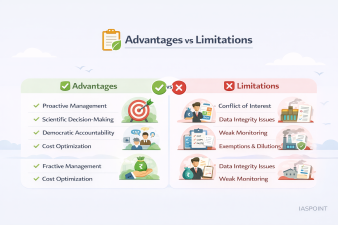
- Proactive Environmental Management: EIA identifies potential ecological risks at the planning stage (ex-ante), allowing for the redesign of projects to avoid sensitive habitats or the adoption of cleaner technologies.
- Scientific Decision-Making: By requiring baseline data on air, water, and soil, EIA ensures that decisions are based on empirical evidence rather than political or economic pressure.
- Democratic Accountability: The Public Hearing component empowers local communities, including tribal and marginalized groups, to voice concerns regarding their livelihoods and environment.
- Cost Optimization: Early identification of environmental risks prevents “sunk costs” in projects that might later be shut down due to judicial intervention or ecological disasters.
- Integration of Mitigation (EMP): It mandates an Environmental Management Plan, ensuring that developers allocate a specific budget for greenbelt development, effluent treatment, and waste management.
Limitations and Structural Bottlenecks
Despite its robust legal framework, the EIA process in India is often criticized by environmentalists for being a “mere formality” and by developers for being a “bottleneck.”
- Conflict of Interest: The project proponent hires the EIA consultant. This often leads to biased reports where environmental impacts are downplayed to ensure the project receives clearance.
- Data Integrity Issues: There have been numerous instances of “cut-copy-paste” in EIA reports, where data from one region is used for a project in a completely different geographic zone.
- Weak Post-Clearance Monitoring: While the pre-clearance process is rigorous, the actual monitoring of whether a company is following the EMP is weak due to the limited manpower of the SPCBs and MoEFCC.
- Exemptions and Dilutions: Frequent amendments to the EIA Notification have moved several polluting industries into the “B2” category (exempt from EIA) or exempted them from Public Hearings, citing “strategic importance” or “ease of doing business.”
- Language and Accessibility Barriers: Public Hearing documents are often technical and provided in English or Hindi, which may not be understood by local communities in non-Hindi speaking or remote tribal regions.
- Exclusion of Cumulative Impacts: Most EIAs are project-specific. They fail to account for the “cumulative impact” of ten different factories operating in the same industrial cluster, leading to “carrying capacity” violations.
Comparison: Ideal vs. Practice
| Feature | Ideal EIA Requirement | Current Practice in India |
| Consultant Role | Independent and Objective | Paid by and accountable to the Proponent |
| Public Hearing | Genuine consultation and consent | Often seen as a procedural hurdle to be “managed” |
| Baseline Data | Multi-season, rigorous primary data | Often based on secondary or outdated data |
| Monitoring | Real-time, strict enforcement | Periodic, paper-based compliance reports |
Recent Trends and “Post-Facto” Controversy
A major point of contention in recent years is the grant of Post-Facto Environmental Clearance, where projects that started without an EC are allowed to apply for regularisation after paying a fine.
- Judicial Stand: The Supreme Court of India has repeatedly held that “Environment Law cannot be a post-facto exercise,” as it defeats the “Precautionary Principle.”
- Administrative Shift: However, recent draft notifications have sought to institutionalize a path for such clearances to prevent the total closure of functional industries and save employment.
Trivia for UPSC Prelims
- The Akshardham Case: One of the most famous cases regarding EIA where the lack of “prior environmental clearance” for a massive construction on the Yamuna floodplains led to prolonged legal battles.
- NABET Accreditation: To curb poor quality reports, only consultants accredited by the National Accreditation Board for Education and Training (NABET) are legally allowed to prepare EIA reports in India.
- Expert Appraisal Committee (EAC): Members of the EAC are experts in fields like ecology, environmental health, and industrial pollution, but they often face criticism for being “pro-industry” due to their appointment by the Ministry.