

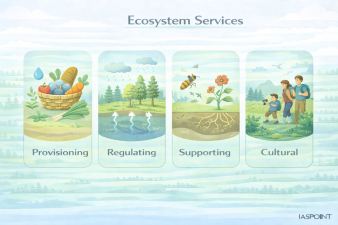
Ecosystem Services are the direct and indirect contributions of ecosystems to human well-being. These include all the benefits that humans derive, both freely and otherwise, from the natural environment and properly functioning ecosystems. The concept was popularized by the Millennium Ecosystem Assessment (MA) launched by the UN in 2001. The global economic value of these services is immense. According to economist Robert Costanza, the estimated value of global ecosystem services is nearly $33 trillion per year, which is significantly higher than the global GDP.
Classification of Ecosystem Services
The Millennium Ecosystem Assessment organizes these services into four distinct categories based on their functional role.
| Category | Description | Examples |
| Provisioning Services | Material or energy outputs from ecosystems. | Food, fresh water, fuel wood, fiber, and medicinal plants. |
| Regulating Services | Benefits obtained from the regulation of ecosystem processes. | Climate regulation, flood control, water purification, and pollination. |
| Supporting Services | Services necessary for the production of all other ecosystem services. | Soil formation, nutrient cycling, and primary production (photosynthesis). |
| Cultural Services | Non-material benefits people obtain from ecosystems. | Spiritual enrichment, recreation, aesthetic values, and educational benefits. |
Detailed Breakdown of Services
1. Provisioning Services (The “Market” Services)
These are physical products harvested from nature.
- Genetic Resources: Provides the basis for crop improvement and biotechnology.
- Biochemicals and Medicines: A vast majority of modern drugs are derived from wild plants (e.g., Quinine from Cinchona bark).
- Energy: Biomass and hydropower are direct products of ecosystem functioning.
2. Regulating Services (The “Protective” Services)
These services act as buffers and regulators of environmental health.
- Carbon Sequestration: Forests and oceans act as “Carbon Sinks,” mitigating global warming.
- Pollination: Insects (Bees, Butterflies) provide services essential for 75% of global food crops.
- Natural Hazard Regulation: Mangroves and coral reefs act as physical barriers against tsunamis and storm surges.
- Waste Decomposition: Microorganisms in soil and water break down organic waste, purifying the environment.
3. Supporting Services (The “Foundation” Services)
These operate over long time scales and are essential for the existence of the other three categories.
- Nutrient Cycling: The movement of Nitrogen, Phosphorus, and Carbon through the biosphere.
- Primary Production: The conversion of solar energy into organic matter by producers.
- Soil Formation: The weathering of rocks and organic accumulation that creates the medium for plant growth.
4. Cultural Services (The “Intangible” Services)
These contribute to the mental and social health of human societies.
- Ecotourism: Economic revenue generated from visiting natural sites (e.g., Jim Corbett NP).
- Sense of Place: The cultural identity of indigenous communities tied to specific landscapes (e.g., Sacred Groves in India).
Economic Valuation: TEEB and Natural Capital
- TEEB (The Economics of Ecosystems and Biodiversity): A global initiative focused on “making nature’s values visible.” Its principal objective is to mainstream the values of biodiversity and ecosystem services into decision-making at all levels.
- Natural Capital: This concept treats the world’s stock of natural assets (geology, soil, air, water, and all living things) as a capital reserve that yields a “flow” of free ecosystem services.
Ecosystem Services in the Indian Context
India’s diverse geography provides unique regional ecosystem services:
- Himalayas: Act as the “Water Tower of Asia,” providing perennial water to the Indo-Gangetic plains and regulating the South Asian Monsoon.
- Wetlands: Act as “Kidneys of the Landscape” by filtering pollutants and recharging groundwater (e.g., Bhoj Wetland).
- Sacred Groves: Community-protected forest patches that serve as gene banks for rare medicinal plants.
UPSC Prelims Trivia: Key Terms
- Payment for Ecosystem Services (PES): A transparent system where the beneficiaries of an ecosystem service (like clean water) pay the landowners or stewards who maintain that ecosystem.
- Bioprospecting: The search for plant and animal species from which medicinal drugs and other commercially valuable compounds can be obtained.
- Ecological Footprint: A measure of human demand on Earth’s ecosystems; it compares human consumption of natural resources with Earth’s ecological capacity to regenerate them.
The “Tragedy of the Commons”
This economic theory describes a situation where individual users, acting independently according to their own self-interest, deplete or spoil shared ecosystem services (like clean air or open-sea fisheries) through their collective action, even though it is clear that it is not in anyone’s long-term interest.
Last Modified: April 18, 2026