
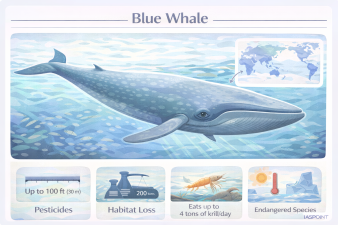
The Blue Whale (Balaenoptera musculus) is the largest animal known to have ever existed on Earth. As a marine mammal belonging to the parvorder Mysticeti (baleen whales), it plays a disproportionately large role in ocean health. In the Indian context, the subspecies Northern Indian Ocean Blue Whale (B. m. indica) is a year-round resident, unlike other migratory populations.
Taxonomy and Subspecies
Scientists recognize several distinct subspecies based on geographic distribution and size.
| Subspecies | Common Name | Geographic Range |
| B. m. musculus | Northern Blue Whale | North Atlantic & North Pacific |
| B. m. intermedia | Antarctic Blue Whale | Southern Ocean (The largest subspecies) |
| B. m. indica | Northern Indian Ocean Blue Whale | Arabian Sea, Bay of Bengal, Sri Lanka |
| B. m. brevicauda | Pygmy Blue Whale | Southern Indian Ocean & South Pacific |
Distribution and Habitat in India
While Blue Whales are found in all the world’s oceans except the Arctic, the Northern Indian Ocean (NIO) population is unique because it does not perform long-distance migrations to the poles.
- Key Sightings: Frequent sightings occur off the coast of Maharashtra (Sindhudurg), Kerala, and the Lakshadweep Islands.
- Sri Lanka Hub: The waters off Mirissa and Trincomalee are global hotspots for the B. m. indica subspecies due to intense seasonal upwelling.
- Habitat: They prefer deep-oceanic waters but are often drawn to continental shelf breaks where nutrient-rich upwelling creates massive swarms of Krill (their primary food).
Conservation Status and Legal Protection
The Blue Whale was hunted to near-extinction during the era of industrial whaling. While populations are slowly recovering, they remain at high risk.
- IUCN Red List: Endangered (The Antarctic subspecies is Critically Endangered).
- CITES: Appendix I (Total ban on international commercial trade).
- CMS (Bonn Convention): Appendix I.
- Wild Life (Protection) Act, 1972 (India): Schedule I (Highest level of legal protection).
- International Whaling Commission (IWC): Protected under the 1966 global ban on commercial whaling.
Ecological Role: The “Whale Pump”
Blue Whales provide critical ecosystem services that act as a nature-based solution to climate change.
- Nutrient Cycling: Through “whale pump” action, they feed at depth and release nutrient-rich fecal plumes at the surface. These plumes are rich in Iron and Nitrogen, which fertilize Phytoplankton.
- Carbon Sequestration: A single Blue Whale can sequester an average of 33 tonnes of CO2 in its body. When it dies, its carcass sinks to the ocean floor (a “whale fall”), locking that carbon away for centuries.
- Oxygen Production: By boosting phytoplankton growth (which produces 50% of the world’s oxygen), whales indirectly support every second breath humans take.
Contemporary Threats (2026 Context)
Despite the ban on hunting, modern anthropogenic activities continue to threaten their survival.
- Ship Strikes: The Northern Indian Ocean has some of the world’s busiest shipping lanes. Large vessels often collide with whales, which is the leading cause of “unnatural” mortality.
- Ocean Noise Pollution: Seismic surveys for oil and gas, military sonar, and shipping noise interfere with the whales’ low-frequency vocalizations used for communication and mating.
- Microplastics: As filter feeders, Blue Whales ingest millions of microplastic particles daily, which can lead to bioaccumulation of toxins.
- Climate Change: Warming oceans alter the distribution of krill, forcing whales to travel further for food, which impacts their reproductive success.
UPSC Prelims: Essential Trivia
- Heart Size: A Blue Whale’s heart is roughly the size of a bumper car, and its tongue can weigh as much as an entire elephant.
- Baleen Plates: Instead of teeth, they have 300–400 fringed plates made of keratin used to filter small crustaceans from seawater.
- Loudness: They are among the loudest animals on Earth; their calls (up to 188 decibels) can be heard by other whales hundreds of miles away.
- NIO Residency: Unlike other baleen whales that migrate to cold waters to feed and warm waters to breed, the Northern Indian Ocean population stays in the tropical Indian Ocean year-round due to the high productivity of the monsoon-driven upwellings.