

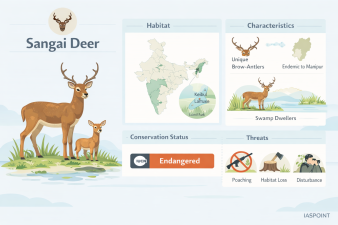
The Sangai (Rucervus eldii eldii), also known as the Brow-antlered Deer or the “Dancing Deer” of Manipur, is one of the rarest and most localized mammals in the world. It is a subspecies of Eld’s deer and is endemic to a single location: the Keibul Lamjao National Park in Manipur. The name “Dancing Deer” comes from its delicate, hopping gait as it navigates the floating biomass of its habitat.
Habitat: The Unique Phumdis of Loktak Lake
The survival of the Sangai is inextricably linked to the unique ecosystem of Loktak Lake, the largest freshwater lake in Northeast India.
- Phumdis: These are floating islands of heterogeneous masses of vegetation, soil, and organic matter in various stages of decay.
- Keibul Lamjao National Park (KLNP): Located in the southeastern part of Loktak Lake, it is the world’s only floating national park. The Sangai lives on the thickest layers of these phumdis.
Physical Characteristics and Behavior
- Antlers: They possess unique “brow-tine” antlers, where the main beam and the brow tine form a continuous curve, making the antlers look like they are coming out of the forehead.
- Adaptation: Their hooves are specially adapted (broad and splayed) to distribute weight evenly, preventing them from sinking into the soft, spongy phumdis.
- Activity: They are primarily crepuscular, meaning they are most active during the twilight hours of dawn and dusk.
Conservation Status and Legal Protection
The Sangai is a high-priority species for UPSC Prelims due to its “Critically Endangered” history and its current “Endangered” status.
| Framework | Status/Category |
| IUCN Red List | Endangered |
| Wildlife Protection Act, 1972 | Schedule I (Highest Protection) |
| CITES | Appendix I |
| State Status | State Animal of Manipur |
Major Threats to the Population
- Habitat Loss: The construction of the Ithai Barrage for the Loktak Hydroelectric Project has maintained a high water level year-round. This prevents the phumdis from touching the lake bed during the dry season to replenish nutrients, causing them to thin out and eventually sink.
- Inbreeding Depression: Since the entire global population (estimated at ~260 individuals) is confined to a single small area, the species suffers from low genetic diversity.
- Poaching: Despite heavy guarding, illegal hunting for meat and antlers remains a threat.
- Invasive Species: The growth of competitive weeds like Para grass displaces the native vegetation that Sangai feeds on.
Conservation Efforts and Relocation Plans
- Sangai Project: A dedicated conservation plan by the Manipur Forest Department involving community-based monitoring and habitat restoration.
- Second Home for Sangai: To prevent extinction due to a localized disaster (like a disease outbreak), the government has identified Pumlen Pat as a potential second habitat for translocation.
- Sangai Festival: An annual cultural festival organized by the Manipur Tourism Department to raise awareness and promote the conservation of the species.
Trivia and Key Facts for Prelims
- Eld’s Deer Subspecies: There are three subspecies of Eld’s Deer: R. e. eldii (Sangai – India), R. e. thamin (Thamin – Myanmar), and R. e. siamensis (Siamese Eld’s Deer – Thailand/Cambodia).
- Montreux Record: Loktak Lake was placed under the Montreux Record (a register of Ramsar sites where changes in ecological character have occurred) in 1993, largely due to the ecological issues affecting the Sangai’s habitat.
- Floating Schools: The presence of the Sangai and the phumdis has led to unique human adaptations, including India’s first floating elementary school on Loktak Lake.