
Marine Protected Areas (MPAs) are geographically defined marine zones where human activity is strictly regulated to protect natural, cultural, or historical resources. In India, MPAs are primarily notified under the Wildlife (Protection) Act, 1972 (WLPA) and supported by the Coastal Regulation Zone (CRZ) Notifications under the Environment (Protection) Act, 1986.
- Definition: Areas including the sea, its bed, and the subsoil, notified as National Parks or Sanctuaries to conserve marine biodiversity.
- Global Legal Link: MPAs generally fall within the Territorial Waters (up to 12 nautical miles) of a nation. The UNCLOS (1982) and the more recent BBNJ Treaty (2023) (High Seas Treaty) provide international frameworks for protecting biodiversity beyond national jurisdictions.
Categories of MPAs in India
Indian MPAs are categorized based on the level of protection and the type of ecosystem they safeguard.
Category I: National Parks and Sanctuaries
These areas have the highest legal protection.
- Marine National Parks: No human activity is permitted except for specific research/management purposes under the Chief Wildlife Warden’s approval.
- Marine Sanctuaries: Limited traditional rights (like artisanal fishing) might be allowed for local communities if it doesn’t harm the wildlife.
Category II: Islands and Coastal Zones
This includes entire islands or coastal stretches designated as protected areas.
- Examples: Andaman and Nicobar Islands, Lakshadweep Islands.
Category III: Coastal Wetlands (Including Ramsar Sites)
Fragile ecosystems that serve as the interface between land and sea.
- Examples: Mangroves (Sundarbans), Estuaries (Bhitarkanika), and Lagoons (Chilika).
Major Marine Protected Areas in India
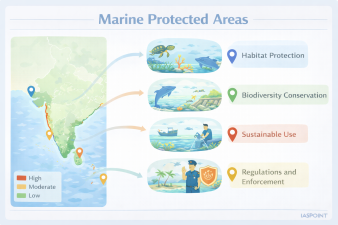
India’s MPAs are distributed across four main zones: the West Coast, the East Coast, the Andaman & Nicobar Islands, and the Lakshadweep Islands.
| MPA Name | Location | Key Biodiversity/Feature |
| Marine National Park | Gulf of Kachchh, Gujarat | India’s first Marine National Park (1982); famous for coral reefs and Dugongs. |
| Gahirmatha Marine Sanctuary | Odisha | World’s largest nesting ground for Olive Ridley Sea Turtles (Arribada). |
| Gulf of Mannar Marine NP | Tamil Nadu | Biosphere Reserve; protects 21 islands; famous for Dugongs (Sea Cow) and coral diversity. |
| Mahatma Gandhi Marine NP | Andaman Islands | Consists of 15 islands; rich in fringing reefs and sea turtles. |
| Rani Jhansi Marine NP | Andaman Islands | Combines mangrove, coral, and rainforest ecosystems. |
| Malvan Marine Sanctuary | Maharashtra | Known for unique coral patches and rich marine flora off the Konkan coast. |
| Bhitarkanika NP | Odisha | Famous for Saltwater Crocodiles and the second largest mangrove ecosystem in India. |
Key Concepts and Regulations
Coastal Regulation Zone (CRZ) and MPAs
The CRZ Notification 2019 classifies ecologically sensitive areas as CRZ-I A. This category includes:
- Mangroves, Coral Reefs, Sand Dunes, Mudflats.
- Turtle nesting grounds and Seagrass beds.
- All MPAs notified under the WLPA 1972.
Ecological Shock Absorbers
- Marine Eco-Sensitive Zones (ESZ): The MoEFCC declares ESZs around Marine National Parks to minimize human impact. India’s first marine ESZ was notified around the Marine National Park in the Gulf of Kachchh.
- Prohibited Activities in MPAs: Commercial mining, setting up of sawmills, hydroelectric projects, and discharge of untreated effluents.
Comparative Facts and Trivia
- Largest Marine National Park: Gulf of Kachchh Marine National Park, Gujarat.
- Smallest Marine National Park: South Button Island National Park, Andaman & Nicobar Islands (only 0.03 sq. km).
- Only Floating Park Connection: While Keibul Lamjao is a freshwater wetland, it is often studied alongside marine systems for its unique “phumdi” ecosystem.
- Schedule I Protection: Under the WLPA, all sea turtles, sea cucumbers, and seahorses are protected under Schedule I, granting them the highest degree of protection against trade and hunting.
Challenges and Recent Developments
- Deep Ocean Mission (2021): Focused on deep-sea mining and biodiversity assessment; however, it must balance extraction with MPA conservation.
- Blue Economy Policy: India’s initiative to sustainably use ocean resources for economic growth while preserving the health of the marine ecosystem.
- BBNJ Treaty (2023): As of 2026, India is in the process of integrating BBNJ guidelines to establish MPAs in the “High Seas” (areas beyond national EEZs).