
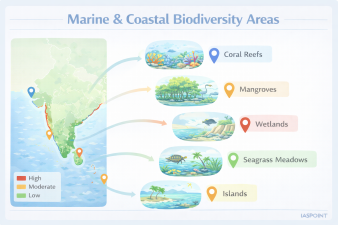
The marine and coastal ecosystems of India are among the most diverse in the world, characterized by an extensive coastline of 7,516 km and an Exclusive Economic Zone (EEZ) exceeding 2 million square km.
Legal and Institutional Framework
India’s marine biodiversity is protected under a tiered legislative structure that balances conservation with the livelihoods of coastal communities.
- Wildlife (Protection) Act, 1972: Provides the primary legal basis for the creation of Marine Protected Areas (MPAs). Species such as Sea Cucumbers, Dugongs, and all types of Sea Turtles are listed under Schedule I, granting them the highest level of protection.
- Environment (Protection) Act, 1986: The umbrella legislation under which the Coastal Regulation Zone (CRZ) notifications are issued.
- Biological Diversity Act, 2002: Focuses on the conservation of biological resources and equitable sharing of benefits through the National Biodiversity Authority (NBA).
- BBNJ Treaty (High Seas Treaty): A landmark international legally binding instrument under UNCLOS for the conservation of marine life in areas beyond national jurisdiction, which entered into force in January 2026.
Coastal Regulation Zone (CRZ) Classification
The CRZ notifications (latest major update in 2019) divide the coastal areas into four distinct categories based on their sensitivity and proximity to the High Tide Line (HTL).
| Zone | Description | Key Restrictions/Features |
| CRZ-I | Ecologically Sensitive Areas (ESAs) | Includes mangroves, coral reefs, and turtle nesting grounds. No new construction is permitted except for specific defense or strategic projects. |
| CRZ-II | Developed Urban Areas | Areas up to the shoreline that are already built up. Construction is allowed but regulated by existing norms. |
| CRZ-III | Rural Areas | Relatively undisturbed areas. Sub-divided into CRZ-III A (densely populated) and CRZ-III B (sparsely populated). Maintain a No Development Zone (NDZ). |
| CRZ-IV | Water Area | Extends from the Low Tide Line (LTL) to 12 nautical miles seaward. Focuses on regulating waste discharge and fishing. |
Marine Protected Areas (MPAs) in India
India has designated several regions as MPAs to safeguard specific habitats. These are categorized into Marine National Parks, Sanctuaries, and Biosphere Reserves.
Major Marine National Parks
- Gulf of Kachchh Marine National Park (Gujarat): India’s first marine national park; famous for its coral reefs and octopus.
- Gulf of Mannar Marine National Park (Tamil Nadu): Part of the first Marine Biosphere Reserve in South Asia; known for the Dugong (Sea Cow).
- Mahatma Gandhi Marine National Park (Andaman Islands): Noted for its fringing reefs and diverse marine life including saltwater crocodiles.
- Rani Jhansi Marine National Park (Andaman & Nicobar): Features a unique combination of mangrove threads and coral reefs.
Significant Marine Sanctuaries
- Gahirmatha Marine Sanctuary (Odisha): The world’s largest nesting ground for the Olive Ridley Sea Turtles (Arribada).
- Malvan Marine Sanctuary (Maharashtra): Protects the rich biodiversity of the Konkan coast, including corals and sea anemones.
Key Marine Ecosystems and Biodiversity Facts
Marine biodiversity is not uniform; it is concentrated in specific “blue” ecosystems that serve as carbon sinks and coastal buffers.
Coral Reefs
India has four major coral reef regions:
- Gulf of Kutch (Northern-most)
- Gulf of Mannar
- Lakshadweep (Atoll reefs)
- Andaman and Nicobar Islands (Fringing reefs) Note: The Sundarbans does NOT have coral reefs due to high turbidity and freshwater inflow from the Ganga-Brahmaputra system.
Mangroves
- Sundarbans (West Bengal): The largest contiguous mangrove forest in the world and a UNESCO World Heritage Site.
- Bhitarkanika (Odisha): Second largest mangrove formation in India; a Ramsar site famous for estuarine crocodiles.
- Pichavaram (Tamil Nadu): One of the largest mangrove forests in India, separated from the sea by a sand bar.
Important Species and Conservation Status
The following table highlights species frequently appearing in UPSC examinations:
| Species | Habitats in India | IUCN Status (General) | WPA 1972 Schedule |
| Dugong (Sea Cow) | Gulf of Mannar, Palk Bay, Andaman Islands | Vulnerable | Schedule I |
| Olive Ridley Turtle | Odisha Coast (Gahirmatha) | Vulnerable | Schedule I |
| Sea Cucumber | Lakshadweep, Gulf of Mannar | Endangered/Vulnerable | Schedule I |
| Irrawaddy Dolphin | Chilika Lake (Odisha) | Endangered | Schedule I |
| Ganges River Dolphin | Ganga-Brahmaputra (Freshwater) | Endangered | Schedule I |
Current Global and National Initiatives (2025-2026)
- 30×30 Target: Under the Kunming-Montreal Global Biodiversity Framework, India is committed to protecting 30% of its land and sea area by 2030.
- MISHTI Scheme: (Mangrove Initiative for Shoreline Habitats & Tangible Incomes) aimed at mangrove plantation along the coastline and on salt pans.
- Blue Economy Policy: Focused on sustainable use of ocean resources for economic growth while preserving the health of the marine ecosystem.
- Deep Ocean Mission: Launched by the Ministry of Earth Sciences for deep-sea mining, biodiversity exploration, and the development of ocean climate change advisory services.