
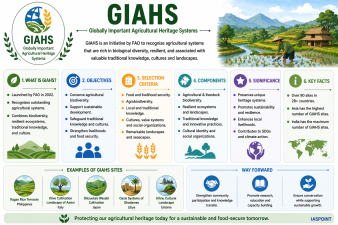
Globally Important Agricultural Heritage Systems (GIAHS) are outstanding landscapes that combine agricultural biodiversity, resilient ecosystems, and a valuable cultural heritage. Established by the Food and Agriculture Organization (FAO) of the United Nations in 2002, this initiative seeks to identify and safeguard traditional farming systems that contribute to food security and sustainable development.
Defining Characteristics of GIAHS
To be designated as a GIAHS site, an agricultural system must represent more than just a landscape; it must be a living, evolving system of human communities in an intricate relationship with their territory.
- Food and Livelihood Security: The system must be a primary source of food and income for the local community.
- Agrobiodiversity: The site must host unique genetic resources, landraces, and endemic species of flora and fauna.
- Local and Traditional Knowledge: Utilization of time-tested indigenous techniques for water management, soil conservation, and crop rotation.
- Cultural Values and Social Organizations: Deeply rooted social structures, rituals, and beliefs that govern the management of natural resources.
- Landscape Features: Aesthetic and functional landscapes created through centuries of human-environment interaction.
GIAHS Sites in India
India currently hosts four recognized GIAHS sites, each representing a unique adaptation to specific climatic and topographical challenges.
| Site Name | State | Type/Significance |
| Kuttanad Below Sea Level Farming System | Kerala | Only system in India where farming is done 1.2m to 3m below sea level; known as the “Rice Bowl of Kerala.” |
| Koraput Traditional Agriculture | Odisha | Notable for the conservation of genetic diversity of paddy; centered around tribal communities and sustainable forest use. |
| Saffron Heritage of Kashmir | Jammu & Kashmir | Focuses on the unique Pampore plateau “Karewa” soil and traditional saffron cultivation techniques. |
| Meghalaya’s Khasi Hill Jhum Farming | Meghalaya | A sophisticated shifting cultivation system that preserves forest cover and soil fertility through traditional ecological knowledge. |
Specific Case Study: Kuttanad Below Sea Level Farming
- Land Reclamation: Farmers utilize “Kayal” (backwater) lands protected by dikes.
- Salinity Management: Specialized methods to prevent seawater intrusion while maintaining nutrient-rich freshwater for paddy.
- Integrated Farming: Combines paddy cultivation with duck rearing and fishing, creating a circular economy within the wetland ecosystem.
Differences Between GIAHS and UNESCO World Heritage Sites
While both aim for conservation, their core objectives differ significantly.
- GIAHS (FAO): Focuses on “living” and “evolving” agricultural systems. The emphasis is on food security, agrobiodiversity, and the livelihood of the farmers.
- World Heritage Sites (UNESCO): Focuses on “outstanding universal value” which is often static (e.g., monuments or specific natural parks). While it includes “Cultural Landscapes,” it does not primarily prioritize agricultural food production as its central pillar.
Global Significance and Impact
- Climate Resilience: GIAHS sites are often more resilient to climate change due to their high biodiversity and reliance on natural cycles rather than chemical inputs.
- Poverty Alleviation: By recognizing these sites, the FAO promotes “Agritourism” and premium branding for local products (like Kashmiri Saffron), increasing income for smallholder farmers.
- Policy Integration: Governments are encouraged to integrate GIAHS conservation into national agricultural policies to prevent the loss of traditional knowledge to modern monocultures.
Facts for UPSC Prelims
- Nodal Agency: The Food and Agriculture Organization (FAO).
- Origin: Launched during the World Summit on Sustainable Development (WSSD) in Johannesburg, 2002.
- Global Count: There are over 80 designated GIAHS sites across 26+ countries worldwide.
- Agrobiodiversity: These sites act as in-situ conservation hubs for wild relatives of cultivated crops, which are vital for future food security and crop breeding.