
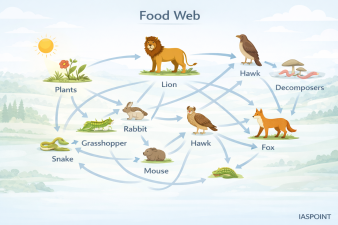
A Food Web is a complex, interlocking network of multiple food chains that illustrates the flow of energy and nutrients through an ecosystem. Unlike a linear food chain, a food web provides a more realistic representation of ecological interactions because most organisms consume more than one type of food and are, in turn, preyed upon by multiple predators.
Key Characteristics of Food Webs
- Multiple Pathways: Energy can follow several different routes from producers to top consumers.
- Trophic Flexibility: An organism can occupy more than one trophic level simultaneously. For example, a crow is a primary consumer when eating grain and a secondary/tertiary consumer when eating insects or small animals.
- Ecosystem Stability: Food webs provide “back-up” systems. If one prey species population declines, the predator can shift to an alternative prey, preventing the collapse of the entire system.
- Non-Linearity: Interactions are multi-directional and interconnected, creating a web-like structure that is more resilient to environmental shocks than a simple chain.
Importance of Food Webs in Ecosystems
The complexity of a food web is often a direct indicator of the health and biodiversity of an ecosystem.
- Stability and Resilience: Greater complexity (more links) usually means higher stability. If one link is broken (e.g., local extinction), the impact is buffered by alternative pathways.
- Population Control: Predators in a food web keep the populations of various prey species in check, preventing any single species from over-consuming the producers.
- Nutrient Recycling: By connecting various trophic levels to decomposers, food webs ensure that nutrients are efficiently returned to the abiotic environment.
Species Roles within a Food Web
| Species Type | Description | Example |
| Keystone Species | A species that has a disproportionately large effect on its environment relative to its biomass. Its removal causes the web to collapse. | Sea Otters, Elephants, Tigers |
| Foundation Species | Primary producers that provide the basic structure of the ecosystem. | Coral polyps, Kelp, Oak trees |
| Umbrella Species | Large species with wide ranges; protecting them indirectly protects many other species in the same web. | Giant Panda, Tiger |
| Link Species | Species that play a critical role in transferring energy between different parts of the web. | Mycorrhizal fungi, Pollinators |
Comparison: Food Chain vs. Food Web
| Feature | Food Chain | Food Web |
| Structure | Linear and simple | Interconnected and complex |
| Energy Flow | Single pathway | Multiple pathways |
| Stability | Low; easily disrupted | High; more resilient |
| Realism | Theoretical/Isolated | Practical/Natural |
| Vulnerability | High (if one level is removed) | Low (due to alternative options) |
[Image comparing a linear food chain and an interconnected food web]
Trophic Levels in a Food Web
While the web is complex, organisms are still grouped into functional levels:
- Basal Species: Usually autotrophs (producers) that require no living tissue for nourishment.
- Intermediate Species: Organisms that act as both predator and prey (herbivores and intermediate carnivores).
- Top Predators (Apex): Organisms at the top of the web that are not preyed upon by any other species within that system.
Ecological Implications for Prelims
- Trophic Cascades: If an apex predator is removed, the “top-down” control is lost, leading to an explosion of intermediate prey species which may then overgraze the producers (e.g., the reintroduction of wolves in Yellowstone).
- Bottom-Up Control: Changes in the population of producers (due to climate or nutrients) ripple upward, affecting the entire food web.
- Connectivity: The “Connectance” of a food web is the ratio of actual links to the tota