
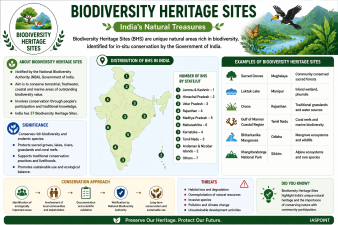
Biodiversity Heritage Sites (BHS) are well-defined areas that are unique, ecologically fragile ecosystems with a high diversity of wild and domesticated species. They are notified under Section 37 of the Biological Diversity Act, 2002.
- Legal Authority: State Governments are empowered to notify BHS in their Official Gazette.
- Consultation Process: The notification is done in consultation with Local Bodies (such as Gram Panchayats or Municipalities) and the State Biodiversity Board (SBB).
- Management: Once notified, the State Government frames rules for the management and conservation of these sites in consultation with the Central Government.
- Compensation: The Act provides for schemes to compensate or rehabilitate any person economically affected by such notification.
Selection Criteria for BHS
A site is considered for BHS status if it fulfills one or more of the following ecological criteria:
- Species Richness: High abundance of wild and domesticated species or intra-specific categories.
- Endemism: Presence of species that are unique to a defined geographic location.
- Threatened Status: Presence of rare, endangered, or threatened species.
- Evolutionary Significance: Areas containing wild ancestors of domestic/cultivated species or their varieties.
- Keystone Species: Presence of species that play a critical role in maintaining the structure of an ecological community.
- Historical/Cultural Value: Presence of fossil beds or sites with significant cultural, ethical, or aesthetic values linked to biodiversity.
Major Biodiversity Heritage Sites in India
As of early 2026, India has notified 54 Biodiversity Heritage Sites across various states. The following table highlights prominent sites essential for UPSC Prelims:
| Site Name | State | Key Features/Significance |
| Nallur Tamarind Grove | Karnataka | First BHS in India (2007); believed to be a relic of the Chola Dynasty. |
| Ameenpur Lake | Telangana | First water body in India to be recognized as a BHS. |
| Majuli Island | Assam | Largest river island in the world; significant for its unique Brahmaputra fluvial system. |
| Yaya Tso | Ladakh | Known as “Birds’ Paradise”; a major breeding site for the Black-necked Crane. |
| Gupteswar Forest | Odisha | Located in the Koraput district; adjacent to a sacred limestone cave shrine. |
| Glory of Allapalli | Maharashtra | A reserved forest patch preserved for its biological and historical values. |
| Kallina Chira | Kerala | A traditional pond system preserving indigenous aquatic flora and fauna. |
| Arittapatti | Tamil Nadu | First BHS of Tamil Nadu; features a chain of seven hillocks (Ezhulagu Malai). |
| Gandarbal BHS | Jammu & Kashmir | Notified for its unique high-altitude wetland ecosystem. |
Significance and Conservation Impact
The declaration of a BHS does not necessarily restrict the prevailing practices and usages of the local communities.
- Community-Led Conservation: Unlike National Parks or Sanctuaries, BHS emphasizes conservation through the participation of local communities (Biodiversity Management Committees).
- Protection of Agrobiodiversity: It protects landraces, folk varieties, and wild relatives of cultivated plants, ensuring food security and genetic diversity.
- Socio-Cultural Integration: Recognizes “Sacred Groves” and areas with spiritual value, integrating traditional knowledge with formal conservation.
- Ecological Corridors: Many sites like Hogrekan (Karnataka) serve as vital wildlife corridors between larger protected areas like National Parks.
Key Trivia for UPSC
- First BHS in India: Nallur Tamarind Grove, Bengaluru, Karnataka.
- State with Maximum BHS: Historically, states like West Bengal, Karnataka, and Odisha have been proactive in notifying multiple sites.
- The “Bird Paradise” of Ladakh: Yaya Tso was the first BHS notified in the Union Territory of Ladakh (2023).
- Section 37(2): Under this section, the State Government may frame schemes for compensating or rehabilitating anyone economically affected by the BHS notification.