

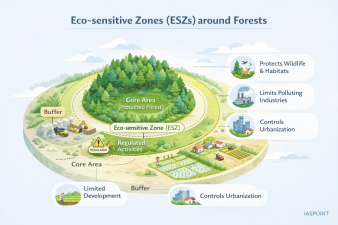
Eco-Sensitive Zones (ESZs), also known as Ecologically Fragile Areas (EFAs), are areas notified by the Ministry of Environment, Forest and Climate Change (MoEFCC) around Protected Areas, National Parks, and Wildlife Sanctuaries. They are established under Section 3(2)(v) of the Environment (Protection) Act, 1986.
- Primary Objective: To create a “shock absorber” or transition zone for protected areas by regulating and managing activities around them.
- Buffer Effect: They act as a transition from areas of high protection to areas of lesser protection.
- Legal Basis: The word “Eco-Sensitive Zone” is not mentioned in the Environment (Protection) Act; it is a nomenclature derived from the powers given to the Central Government to restrict industrial operations in certain areas.
Extent and Boundaries
- The 10 km Rule: Generally, the width of an ESZ can extend up to 10 kilometers around a protected area.
- Flexible Width: If sensitive ecological corridors, connectivity, and ecologically significant patches crucial for landscape linkage are even beyond 10 km width, these can be included in the ESZ.
- Zero Extent: In some cases, such as the Guindy National Park (Tamil Nadu) or areas with dense urban settlements, the ESZ can be nearly zero or limited to a few meters.
Classification of Activities in ESZs
Activities within an ESZ are categorized into three distinct groups to balance conservation with local livelihoods:
| Category | Description | Examples |
| Prohibited | Activities that are strictly not allowed due to high ecological impact. | Commercial mining, setting up sawmills, polluting industries, major hydroelectric projects. |
| Regulated | Activities allowed only with prior permission and strict monitoring. | Felling of trees, establishment of hotels/resorts, drastic change of agriculture system. |
| Permitted | Activities encouraged to promote sustainable development. | Ongoing agriculture/horticulture, rainwater harvesting, organic farming, use of renewable energy. |
Management and Monitoring
- Zonal Master Plan (ZMP): State governments are required to prepare a Zonal Master Plan for each ESZ within two years of notification. It is prepared with the involvement of local communities.
- Monitoring Committee: A high-level monitoring committee, usually headed by a retired Judge or a District Collector, ensures compliance with the guidelines.
- Role of BMCs: Biodiversity Management Committees at the local level play a consultative role in maintaining the ecological integrity of these zones.
Landmark Judicial Interventions
The implementation of ESZs has been heavily influenced by the Supreme Court of India:
- SC Order (June 2022): The Court initially mandated a minimum 1 km ESZ for every protected area in India.
- Modification (April 2023): The Supreme Court modified its earlier order, stating that the 1 km rule cannot be a “one-size-fits-all” solution, especially where ESZs have already been notified or are near international borders/urban centers.
- Prohibition of Mining: Permanent stay on mining activities within 1 km of any National Park or Wildlife Sanctuary.
Importance of ESZs
- Mitigating Man-Animal Conflict: By regulating land use, ESZs prevent the fragmentation of habitats, reducing the entry of wild animals into human settlements.
- Ecosystem Services: They protect the “lungs” of urban areas and ensure the recharge of groundwater and maintenance of local micro-climates.
- Community Involvement: Unlike the “core” of a National Park, ESZs allow for human habitation and sustainable use, integrating locals into the conservation narrative.
Critical Trivia for UPSC
- Gadgil vs. Kasturirangan Committee: These committees were specifically formed to identify ESZs in the Western Ghats. The Gadgil commission recommended the entire Western Ghats be declared as an ESZ, while Kasturirangan suggested roughly 37%.
- State with Highest ESZ Proposals: Historically, Odisha, Karnataka, and Maharashtra have submitted the highest number of ESZ proposals to the MoEFCC.
- No Disruption Rule: Guidelines specify that ESZ notification should not lead to the displacement of local people or the disruption of their traditional rights.