
Nature-based Solutions (NbS) are actions to protect, sustainably manage, and restore natural and modified ecosystems that address societal challenges effectively and adaptively, simultaneously providing human well-being and biodiversity benefits. Coined by the International Union for Conservation of Nature (IUCN), the concept emphasizes that healthy ecosystems are not just victims of climate change, but essential tools in fighting it.
The IUCN Global Standard for NbS
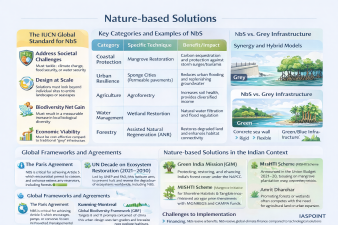
To prevent “greenwashing,” the IUCN established eight criteria that define a true Nature-based Solution.
- Address Societal Challenges: Must tackle issues like climate change, food security, or water security.
- Design at Scale: Solutions must look beyond individual sites to entire landscapes or seascapes.
- Biodiversity Net Gain: Must result in a measurable increase in local biological diversity.
- Economic Viability: Must be cost-effective compared to traditional “grey” infrastructure.
- Inclusive Governance: Must involve local communities and indigenous peoples in decision-making.
- Adaptive Management: Must be flexible enough to change based on monitoring and new data.
Key Categories and Examples of NbS
NbS are often categorized by the type of ecosystem and the specific challenge they address.
| Category | Specific Technique | Benefit/Impact |
| Coastal Protection | Mangrove Restoration | Carbon sequestration and protection against storm surges/tsunamis. |
| Urban Resilience | Sponge Cities (Permeable pavements) | Reduces urban flooding and replenishes groundwater. |
| Agriculture | Agroforestry | Increases soil health, provides diversified income, and sequesters carbon. |
| Water Management | Wetland Restoration | Natural water filtration and flood regulation. |
| Forestry | Assisted Natural Regeneration (ANR) | Restores degraded land and enhances habitat connectivity. |
NbS vs. Grey Infrastructure
Traditional engineering (Grey Infrastructure) is often rigid and single-purpose, whereas NbS (Green/Blue Infrastructure) provides multi-functional benefits.
Synergy and Hybrid Models
In many modern contexts, a “Green-Grey” hybrid approach is used. For example, a concrete sea wall (grey) may be supplemented with a mangrove fringe (green) to reduce maintenance costs and improve the wall’s lifespan by absorbing initial wave energy.
Global Frameworks and Agreements
NbS is increasingly recognized as a vital component of international environmental policy.
The Paris Agreement
NbS is critical for achieving Article 5, which encourages parties to conserve and enhance carbon sinks and reservoirs, including forests. Approximately 30% of the mitigation needed to limit warming to 1.5°C can be achieved through NbS.
UN Decade on Ecosystem Restoration (2021–2030)
Led by UNEP and FAO, this initiative aims to prevent, halt, and reverse the degradation of ecosystems worldwide, positioning NbS at the center of global recovery efforts.
Kunming-Montreal Global Biodiversity Framework (GBF)
Target 8 and Target 11 of the GBF explicitly mention the use of nature-based solutions to minimize the impact of climate change and enhance ecosystem functions.
Nature-based Solutions in the Indian Context
India’s National Action Plan on Climate Change (NAPCC) and various state-level initiatives incorporate NbS principles.
Green India Mission (GIM)
One of the eight missions under NAPCC, it focuses on protecting, restoring, and enhancing India’s diminishing forest cover and responding to climate change through a combination of adaptation and mitigation measures.
MISHTI Scheme (Mangrove Initiative for Shoreline Habitats & Tangible Incomes)
Announced in the Union Budget 2023-24, this scheme focuses on mangrove plantation along the coastline and on salt pan lands, utilizing MGNREGS and CAMPA funds.
Amrit Dharohar
An initiative to promote unique conservation values of Ramsar Sites in India, focusing on wise use of wetlands to support biodiversity and local livelihoods.
Challenges to Implementation
- Financing: Despite their benefits, NbS receive only a small fraction of global climate finance compared to technological solutions.
- Long Lead Times: Ecosystems take years to mature and provide full protective services, unlike a dam or wall which is functional immediately upon completion.
- Land Competition: Restoring forests or wetlands often competes with the need for agricultural land or urban expansion.
Trivia and Factoids for UPSC Prelims
- Blue Carbon: Carbon captured by the world’s ocean and coastal ecosystems (mangroves, seagrasses, salt marshes). It can store up to 10 times more carbon per unit area than terrestrial forests.
- The Great Green Wall: An African-led initiative to grow an 8,000km natural wonder across the entire width of Africa to fight desertification in the Sahel.
- Sponge City Concept: Originally popularized in China, this urban design uses rain gardens and bioswales to soak up every drop of rain, preventing floods.
- REDD+: A UN-backed framework that provides financial incentives to developing countries for Reducing Emissions from Deforestation and Forest Degradation, a core NbS mechanism.