
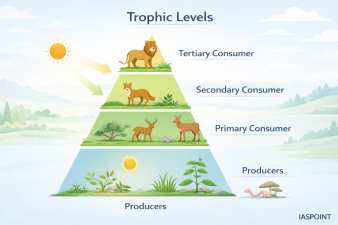
A Trophic Level represents a specific place occupied by an organism in a food chain based on its source of nutrition or food. In any ecosystem, energy flows from the sun to producers and then through various levels of consumers. This step-by-step transfer of energy is called the Trophic Structure.
Classification of Trophic Levels
Organisms are assigned to trophic levels based on their functional role.
| Trophic Level | Category | Source of Energy | Examples |
| First (T1) | Producers (Autotrophs) | Solar energy / Photosynthesis | Grass, Trees, Phytoplankton, Algae |
| Second (T2) | Primary Consumers (Herbivores) | Producers | Deer, Rabbit, Zooplankton, Grasshopper |
| Third (T3) | Secondary Consumers (Carnivores) | Primary Consumers | Frog, Small Fish, Wolf, Snake |
| Fourth (T4) | Tertiary Consumers (Top Carnivores) | Secondary Consumers | Lion, Tiger, Hawk, Shark |
Key Principles of Energy Flow
The movement of energy across trophic levels is governed by specific biological and physical laws that are critical for UPSC Prelims.
Unidirectional Flow
Energy flow in an ecosystem is always non-cyclic and unidirectional. Energy enters the system from the sun, is captured by producers, and moves toward top carnivores. It never flows back from consumers to producers.
Lindeman’s 10% Law
Introduced by Raymond Lindeman in 1942, this law states that during the transfer of organic food energy from one trophic level to the next, only about 10% of the energy is stored as flesh. The remaining 90% is lost during transfer, broken down in respiration, or lost as incomplete digestion.
- Implication: Because of this drastic energy loss, food chains are usually limited to 4 or 5 trophic levels. Beyond this, the energy available is insufficient to support a viable population.
Ecological Pyramids
Ecological pyramids are graphical representations of the relationship between different trophic levels in terms of energy, biomass, or number.
- Pyramid of Numbers: Can be upright (Grassland), partly upright, or inverted (Parasitic food chain, e.g., many birds on a single tree).
- Pyramid of Biomass: Usually upright for terrestrial ecosystems but inverted for aquatic ecosystems (where the biomass of phytoplanktons is smaller than that of the fishes consuming them).
- Pyramid of Energy: This is always upright. It can never be inverted because energy is lost at every step as heat.
Related Ecological Phenomena
Understanding how substances move through these levels is vital for environmental toxicology questions.
Bioaccumulation
This refers to the increase in the concentration of a pollutant in a single organism over time. It occurs when an organism absorbs a substance at a rate faster than that at which the substance is lost or eliminated.
Biomagnification (Biological Magnification)
This refers to the increase in the concentration of a persistent toxin (like DDT or Mercury) as it moves up the food chain.
- Requirement: The pollutant must be long-lived, mobile, soluble in fats, and biologically active.
- Result: Top carnivores (like Eagles or Humans) suffer the highest concentration of toxins.
Trophic Cascade
An ecological phenomenon triggered by the addition or removal of top predators, leading to reciprocal changes in the relative populations of predator and prey through a food chain. For example, removing wolves (Top Carnivore) leads to an overpopulation of deer (Herbivores), which results in overgrazing and the destruction of forest vegetation (Producers).
Trivia for Prelims
- Detritus Food Chain (DFC): Unlike the Grazing Food Chain (GFC) which starts with green plants, the DFC starts with dead organic matter. In terrestrial ecosystems, a much larger fraction of energy flows through the DFC than through the GFC.
- Standing Crop: The total mass of living material (biomass) at a particular trophic level at a given time. It is measured as the mass of living organisms (biomass) or the number in a unit area.