
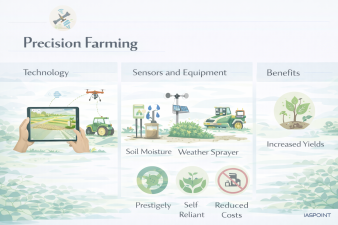
Precision Farming (PF), also known as Satellite Farming or Site-Specific Crop Management (SSCM), is a technology-enabled agricultural management system that ensures crops and soil receive exactly what they need for optimum health and productivity. The goal is to ensure profitability, sustainability, and protection of the environment. Unlike traditional farming, which treats an entire field as a single unit, precision farming recognizes spatial and temporal variability within a single plot of land.
Core Technologies and Tools
Precision farming integrates various high-tech tools to gather data and automate farm operations.
- Global Positioning System (GPS): Enables farmers to map their fields with high accuracy, guiding tractors and drones to avoid overlaps or gaps in input application.
- Geographic Information System (GIS): Used to store, analyze, and display agricultural data like soil pH, nutrient levels, and previous yields in a visual “map” format.
- Remote Sensing: Uses satellites (like RISAT or Resourcesat) and Unmanned Aerial Vehicles (UAVs/Drones) to monitor crop health via spectral signatures.
- Variable Rate Technology (VRT): Equipment that automatically adjusts the rate of seeds, fertilizers, or pesticides applied based on real-time data from sensors or pre-made maps.
- Internet of Things (IoT) & Sensors: Soil moisture sensors, nitrogen sensors, and weather stations provide hyper-local data to a central AI dashboard.
Government Framework and Initiatives (2025-2026)
The Government of India has transitioned from generic subsidies to technology-driven incentives to promote “Smart Farming.”
- Digital Agriculture Mission (2021-2026): A flagship initiative to build a national digital ecosystem (AgriStack) that provides farmers with end-to-end services, from crop planning to market linkages.
- Bharat-VISTAAR (2026): Proposed in the Union Budget 2026-27, this is a multilingual AI tool designed to integrate the AgriStack portals and ICAR research with AI-driven agricultural advisory for precision tasks.
- National Pest Surveillance System (NPSS): Launched in 2024, it uses AI and Machine Learning to detect pest infestations early, allowing for “targeted” rather than “blanket” pesticide application.
- Precision Farming Development Centres (PFDCs): A network of 22 centers established across India’s agro-climatic zones (e.g., at IARI New Delhi, TNAU Coimbatore) to develop and disseminate regionally specific technologies like fertigation and plastic mulching.
- Drone Shakti Scheme: Promotes “Drones as a Service” (DrAAS) for precision spraying of pesticides and nutrients, significantly reducing chemical exposure for farmers.
Environmental and Economic Impacts
| Parameter | Impact of Precision Farming | Environmental Significance |
| Water Usage | Reduction by 30%–50% | Conserves groundwater; reduces energy for pumping. |
| Fertilizer Use | Reduction by 20%–25% | Prevents Eutrophication and nitrate leaching into water bodies. |
| Crop Yield | Increase of 15%–30% | Enhances food security without expanding land area. |
| Carbon Footprint | Reduction by 15%–25% | Lower fuel consumption (GPS-guided tractors) and optimized soil carbon. |
| Input Costs | Reduction by 15%–20% | Improves the Benefit-Cost (B:C) ratio for smallholders. |
Comparison: Traditional vs. Precision Farming
| Feature | Traditional Farming | Precision Farming |
| Input Application | Uniform/Blanket (Same for whole field) | Variable/Targeted (Based on site needs) |
| Decision Making | Based on experience/intuition | Based on real-time data and AI analytics |
| Resource Efficiency | Low (High wastage) | High (Optimal utilization) |
| Environment Impact | High risk of runoff/contamination | Minimal footprint; sustainable |
Challenges in the Indian Context
- High Initial Investment: Technologies like GPS-guided tractors or IoT sensors are expensive for the 86% of Indian farmers who are small and marginal.
- Fragmented Landholdings: Small field sizes make it difficult to operate large-scale precision machinery.
- Digital Divide: Lack of high-speed internet in remote villages and low digital literacy among elderly farmers.
- Data Privacy: Concerns regarding the ownership and security of the “AgriStack” data collected from private farms.
Trivia for Prelims
- “Fertigation”: A key precision technique where fertilizers are dissolved and distributed via drip irrigation, ensuring nutrients reach the root zone directly.
- Normalized Difference Vegetation Index (NDVI): A common metric used in remote sensing to assess whether a target contains live green vegetation or not.
- The Dalwai Committee: The committee on “Doubling Farmers’ Income” identified precision farming as a primary pillar for increasing resource-use efficiency.
- First “Smart” State: Tamil Nadu’s Precision Farming Project (TNPFP) is often cited as a pioneer in demonstrating 30% to 200% yield increases in horticultural crops.