
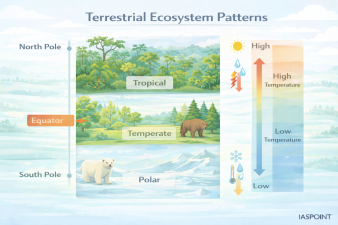
Terrestrial ecosystems exhibit distinct patterns based on geographical coordinates (latitude) and physical elevation (altitude). These patterns are primarily driven by the Temperature-Moisture Gradient, which dictates the distribution, density, and diversity of biological communities.
Latitudinal Patterns: The Global Distribution
As one moves from the Equator toward the Poles, biodiversity generally decreases while the degree of specialization and biomass production changes significantly.
- Tropical Zone (0° to 20° N/S): Characterized by high solar insolation and consistent rainfall. It hosts the highest primary productivity and species richness. The “Equatorial Belt” lacks distinct seasonality.
- Sub-Tropical and Temperate Zones (20° to 60° N/S): Marked by distinct seasonality (Spring, Summer, Autumn, Winter). The ecosystems here transition from deserts and savannas to deciduous forests and prairies.
- Boreal/Polar Zones (60° to 90° N/S): Defined by extreme cold and limited growing seasons. Diversity is low, but the population of individual species (e.g., Conifers in Taiga) can be vast.
Altitudinal Zonation: The Vertical Gradient
Changes in ecosystem types with increasing altitude on a mountain are remarkably similar to changes observed with increasing latitude. This is known as Altitudinal Zonation.
| Altitude Level | Corresponding Latitudinal Biome | Characteristic Vegetation |
| Base/Foothills | Tropical / Sub-tropical | Tropical Evergreen or Deciduous Forest |
| Montane (Middle) | Temperate | Broad-leaved Deciduous (Oak, Chestnut) |
| Sub-Alpine | Taiga (Boreal) | Coniferous (Pine, Deodar, Silver Fir) |
| Alpine | Tundra | Alpine Meadows, Lichens, Mosses |
| Nival (Summit) | Arctic/Polar | Permanent Snow, no vegetation |
Fundamental Ecological Concepts in Patterns
1. The Concept of Ecotone
An ecotone is a zone of junction or a transition area between two or more diverse ecosystems (e.g., the area between a forest and a grassland).
- Edge Effect: The tendency for increased variety and density of species in an ecotone.
- Edge Species: Organisms that occur primarily or most abundantly in the ecotone (e.g., certain bird species that thrive at forest edges).
2. Ecological Succession
Terrestrial patterns also change over time through succession, moving from a Seral Stage (pioneer community) to a Climax Community (stable, final stage).
- Primary Succession: Occurs on bare land where no life existed before (e.g., volcanic rock).
- Secondary Succession: Occurs where an ecosystem was destroyed (e.g., after a forest fire); it is faster because soil and seeds are already present.
Factors Influencing Ecosystem Patterns
Climatic Controls
- Precipitation: Determines whether an ecosystem will be a forest (high rain), grassland (moderate rain), or desert (low rain).
- Temperature: Influences the metabolic rates and the length of the growing season.
Edaphic (Soil) Factors
- Soil pH, mineral content, and water-holding capacity determine which plant species can survive, thereby influencing the higher trophic levels.
Topography
- Slope Aspect: In the Northern Hemisphere, south-facing slopes receive more sunlight and are often drier and warmer than north-facing slopes, leading to different micro-ecosystems on the same mountain.
Comparative Productivity Table
The Net Primary Productivity (NPP) varies across terrestrial ecosystems based on the availability of sunlight, water, and nutrients.
| Ecosystem Rank | Type | Estimated NPP (g/m2/year) |
| 1 (Highest) | Tropical Rainforests | 2000 – 2500 |
| 2 | Tropical Deciduous Forests | 1500 – 1800 |
| 3 | Temperate Forests | 1200 – 1300 |
| 4 | Savannas | 800 – 1000 |
| 5 | Temperate Grasslands | 500 – 600 |
| 6 (Lowest) | Deserts and Tundra | Less than $100$ |
Important UPSC Trivia: Raunkiaer’s Life Forms
Ecologist C. Raunkiaer classified plants based on the place where their “resting buds” are located to survive unfavorable seasons, which reflects terrestrial patterns:
- Phanerophytes: Buds high on branches (Tropical/Forests).
- Chamaephytes: Buds near the ground (Tundra/Cold regions).
- Cryptophytes: Buds buried in soil (Grasslands/Bulbs).
- Therophytes: Survival through seeds only (Deserts/Annuals).