
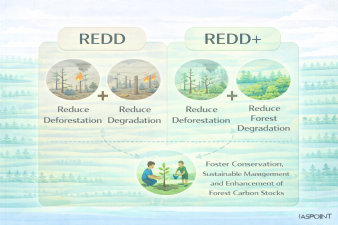
REDD and REDD+ are international climate change mitigation mechanisms developed under the UNFCCC. They aim to provide financial incentives to developing countries to reduce emissions from forested lands and invest in low-carbon paths to sustainable development.
Evolution: From REDD to REDD+
While often used interchangeably, there is a technical distinction in their scope and objectives.
1. REDD (Reducing Emissions from Deforestation and Forest Degradation)
- Origins: First introduced at COP-11 (Montreal, 2005).
- Core Focus: Strictly limited to reducing greenhouse gas emissions by preventing the permanent loss of forests (deforestation) and the reduction in forest quality (degradation).
- Limitation: It did not account for the carbon stored in growing forests or the value of conservation.
2. REDD+ (The Expanded Framework)
- Origins: Formally recognized at COP-16 (Cancun, 2010).
- Scope: It goes beyond just “reducing emissions” to include the following five activities:
- Reducing emissions from deforestation.
- Reducing emissions from forest degradation.
- Conservation of forest carbon stocks.
- Sustainable management of forests.
- Enhancement of forest carbon stocks (e.g., afforestation and reforestation).
The Warsaw Framework for REDD+ (WFR)
Adopted at COP-19 (2013), the Warsaw Framework provides the “rulebook” for REDD+ implementation. It outlines the four design elements (pillars) that a country must have in place to access results-based payments:
- National Strategy or Action Plan: A roadmap for addressing drivers of deforestation.
- Forest Reference Emission Level (FREL): A baseline against which future emissions reductions are measured.
- National Forest Monitoring System (NFMS): A robust system for transparent reporting of forest-related data.
- Safeguard Information System (SIS): A system to ensure that the “Cancun Safeguards” are being respected.
The Cancun Safeguards
To prevent negative social or environmental impacts, REDD+ activities must adhere to seven safeguards (Decision 1/CP.16):
- Consistency with national forest programs and international agreements.
- Transparent and effective national forest governance structures.
- Respect for the knowledge and rights of Indigenous Peoples and local communities.
- Full and effective participation of relevant stakeholders.
- Conservation of natural forests and biological diversity (no conversion of natural forests to plantations).
- Actions to address the risks of reversals (where carbon saved is later released).
- Actions to reduce displacement of emissions (leakage to other areas).
Legal Status and the Paris Agreement
- Article 5 of the Paris Agreement (2015): Explicitly recognizes REDD+ as a key instrument for climate mitigation. It encourages Parties to implement and support the existing framework (Warsaw Framework).
- Financing: Payments are results-based, meaning countries are paid only after they prove they have reduced emissions through a rigorous Measurement, Reporting, and Verification (MRV) process.
India’s Position and Status
- Net Carbon Sink: India is a net carbon sink, meaning its forests absorb more CO2 than they emit.
- National REDD+ Strategy: Released by the Ministry of Environment, Forest and Climate Change (MoEFCC) in 2018. It aims to achieve India’s NDC target of creating an additional carbon sink of 2.5 to 3 billion tonnes of CO2 equivalent by 2030.
- Himalayan Focus: India emphasizes that REDD+ should not just focus on tropical forests but also on temperate and sub-tropical forests in the Himalayan region.
- Green Credit Program (2023): India has linked forest restoration under REDD+ concepts to its market-based Green Credit mechanism to incentivize private and community participation.
Summary Comparison: REDD vs. REDD+ vs. UN-REDD
| Feature | REDD | REDD+ | UN-REDD |
| Focus | Emissions reduction only. | Emissions reduction + Conservation + Management. | A collaborative UN program (FAO, UNDP, UNEP). |
| Nature | Concept/Incentive. | UNFCCC Framework/Mechanism. | Technical Assistance & Capacity Building. |
| Mandate | COP-11 (2005). | COP-16 (2010). | Launched in 2008. |
| Goal | Stop forest loss. | Enhance carbon stocks & biodiversity. | Help countries get “REDD+ ready.” |
Important Facts for UPSC Prelims
- Leakage: A phenomenon where forest protection in one area leads to increased deforestation in another area to meet the same demand. REDD+ is designed to minimize this.
- Permanence: The risk that sequestered carbon may be released back into the atmosphere (e.g., due to a forest fire).
- Additionality: The requirement that the emissions reductions achieved by a REDD+ project must be “additional” to what would have happened in a “business-as-usual” scenario.
- Global Forest Watch (GFW): An online platform often used by stakeholders to monitor forest loss and support REDD+ MRV processes.