
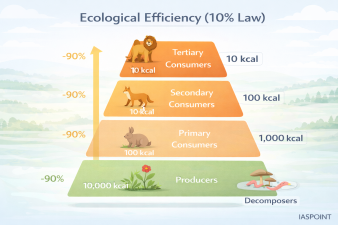
Ecological Efficiency refers to the efficiency with which energy is transferred from one trophic level to the next. It is a measure of the fraction of energy that is converted into biomass at a higher trophic level compared to the energy available at the lower level. In most ecosystems, this efficiency is remarkably low.
Lindeman’s 10% Law
The 10% Law was proposed by Raymond Lindeman in 1942. It serves as a foundational principle for understanding energy dynamics in the biosphere.
- The Principle: During the transfer of organic food energy from one trophic level to the next higher level, only about 10% of the energy is stored as new biomass (flesh).
- The Loss: The remaining 90% of energy is lost to the environment, primarily through:
- Metabolic Respiration: Energy used for movement, growth, and reproduction.
- Heat Loss: Dissipation as a byproduct of chemical reactions (Second Law of Thermodynamics).
- Incomplete Digestion: Energy excreted as waste (feces).
- Natural Death: Energy contained in parts of organisms not eaten by the consumer (e.g., bones, roots).
Mathematical Representation
The efficiency can be calculated using the following formula:
Trophic Levels and Energy Availability
Because of the drastic reduction in energy at each step, the number of trophic levels in an ecosystem is naturally restricted.
| Trophic Level | Category | Energy Available (Example) |
| First (T1) | Primary Producers | 10,000 kcal |
| Second (T2) | Primary Consumers (Herbivores) | 1,000 kcal |
| Third (T3) | Secondary Consumers (Carnivores) | 100 kcal |
| Fourth (T4) | Tertiary Consumers (Top Carnivores) | 10 kcal |
Key Implications for UPSC Prelims
- Limitation of Food Chains: Energy depletion is the reason why most food chains do not exceed 4 or 5 levels. Beyond this, the energy is insufficient to support a breeding population of a higher predator.
- Biomass Distribution: This law explains why the total biomass of producers is significantly higher than the biomass of top carnivores (forming the Upright Pyramid of Biomass in terrestrial systems).
- Apex Predator Vulnerability: Species at the top of the food chain (e.g., Tigers, Eagles) require massive territories to hunt because the energy “per unit area” reaching their level is very low.
- Vegetarianism and Efficiency: From an ecological perspective, shorter food chains are more efficient. If humans eat grain directly (T1 → T2), more energy is available compared to eating livestock that consumed the grain (T1 → T2 → T3).
Related Concepts: Assimilation and Production Efficiency
For a deeper technical understanding, ecological efficiency is the product of two other efficiencies:
- Assimilation Efficiency: The percentage of ingested food that is actually absorbed by the gut and not excreted. (Higher in carnivores than herbivores).
- Net Production Efficiency: The percentage of assimilated energy that is used for growth and reproduction rather than respiration. (Higher in cold-blooded animals like fish than in warm-blooded mammals).
Fact Check: Exceptions to the 10% Rule
While 10% is the global average, actual efficiency can vary:
- In highly productive aquatic systems, it may be slightly higher (up to 15-20%).
- In harsh environments like deserts, it may be much lower.
- Net Photosynthetic Efficiency: Plants are even less efficient at the start; they convert only about 1% of total incident solar radiation into GPP.