

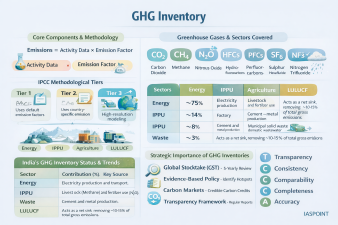
A Greenhouse Gas (GHG) Inventory is a type of emission inventory that quantifies the amount of greenhouse gases emitted into or removed from the atmosphere over a specific period. For a nation, it serves as a critical baseline for climate policy, helping to track progress toward Nationally Determined Contributions (NDCs) under the Paris Agreement.
Core Components and Methodology
The preparation of a GHG inventory follows a standardized scientific approach to ensure consistency across different countries and organizations.
The Basic Calculation Formula
Emissions are generally not measured directly but are calculated using the following equation: Emissions = Activity Data × Emission Factor
- Activity Data: The extent to which a human activity takes place (e.g., tonnes of coal burnt, kilometers driven).
- Emission Factor (EF): A coefficient that quantifies the emissions or removals per unit of activity.
IPCC Methodological Tiers
The Intergovernmental Panel on Climate Change (IPCC) defines three “Tiers” representing levels of methodological complexity:
- Tier 1: Uses default emission factors provided by the IPCC; most basic and least data-intensive.
- Tier 2: Uses country-specific emission factors derived from national data.
- Tier 3: The most complex, involving high-resolution modeling and direct measurements of specific processes.
Greenhouse Gases and Sectors Covered
National inventories typically cover the seven primary greenhouse gases identified under the Kyoto Protocol and the Paris Agreement.
Primary Gases Measured
- Carbon Dioxide (CO2)
- Methane (CH4)
- Nitrous Oxide (N2O)
- Hydrofluorocarbons (HFCs)
- Perfluorocarbons (PFCs)
- Sulphur Hexafluoride (SF6)
- Nitrogen Trifluoride (NF3)
Standard Reporting Sectors
Inventories are organized into five primary sectors according to the 2006 IPCC Guidelines:
- Energy: Fuel combustion (power plants, transport) and fugitive emissions from fuels.
- Industrial Processes and Product Use (IPPU): Non-energy related emissions from industrial chemistry (e.g., cement, chemical production).
- Agriculture: Livestock (enteric fermentation), rice cultivation, and soil management.
- Waste: Solid waste disposal, wastewater treatment, and incineration.
- Land Use, Land-Use Change, and Forestry (LULUCF): Captures both emissions and “removals” (carbon sinks) from forests and soil.
India’s GHG Inventory Status and Trends
India submits its GHG inventory through National Communications (NC) and Biennial Update Reports (BUR) to the UNFCCC.
Recent Inventory Data (Based on India’s BUR-4)
| Sector | Contribution (%) | Key Source |
| Energy | ~75% | Electricity production and transport. |
| Agriculture | ~14% | Livestock (Methane) and fertilizer use (N2O). |
| IPPU | ~8% | Cement and metal production. |
| Waste | ~3% | Municipal solid waste and domestic wastewater. |
| LULUCF | (Offset) | Acts as a net sink, removing ~10-15% of total gross emissions. |
Significant Achievements
- Emission Intensity: India has successfully reduced the emission intensity of its GDP by over 33% between 2005 and 2019, surpassing its early voluntary targets.
- Forest Sink: India is one of the few countries where the LULUCF sector consistently acts as a significant carbon sink, helping to offset gross emissions.
Strategic Importance of GHG Inventories
A robust inventory system is the backbone of global climate governance for several reasons:
- Global Stocktake (GST): Inventories provide the primary data used in the Paris Agreement’s 5-yearly review of collective progress.
- Evidence-Based Policy: Helps governments identify “hotspots” or high-emitting sectors to prioritize for decarbonization subsidies or regulations.
- Carbon Markets: High-quality inventory data (especially Tier 2 and Tier 3) is essential for establishing the credibility of carbon credits and trading systems.
- Transparency Framework: Under the Enhanced Transparency Framework (ETF), all parties must provide regular inventory reports to build international trust.
Key Principles of Inventory Quality (TCCCA)
To be accepted by the UNFCCC, an inventory must adhere to five quality principles:
- Transparency: Assumptions and methodologies must be clearly documented.
- Consistency: The same methodology should be used for the entire time series.
- Comparability: Reports should be formatted such that they can be compared across countries.
- Completeness: All relevant sources and sinks within the geographic boundary must be covered.
- Accuracy: Uncertainties must be reduced and bias eliminated as much as possible.
India’s Institutional Mechanism: NIMS
India is establishing a National Inventory Management System (NIMS) to institutionalize the inventory preparation process. This involves:
- Nodal Agency: Ministry of Environment, Forest and Climate Change (MoEFCC).
- Technical Support: Expert institutions like the Forest Survey of India (FSI) for LULUCF and various CSIR labs for industrial data.
- Objective: To move from periodic “project-based” reporting to a continuous, high-frequency “system-based” reporting mechanism.