

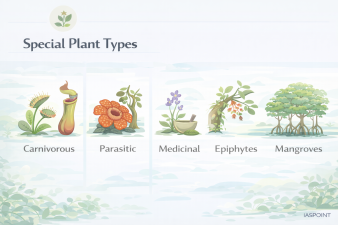
Beyond the standard classification of plants, several groups have evolved unique physiological and morphological traits to survive in extreme or nutrient-deficient environments.
Insectivorous (Carnivorous) Plants
These plants grow in nitrogen-deficient soils (often acidic bogs or marshes) and obtain essential nutrients by trapping and digesting insects.
| Species Name | Mechanism | Found in India |
|---|---|---|
| Pitcher Plant (Nepenthes khasiana) | Passive pitfall trap; leaves form a jug with digestive fluid. | Endemic to Meghalaya (Khasi, Jaintia, and Garo hills). |
| Sundew (Drosera spp.) | Flypaper trap; uses mucilage (sticky “dew”) to entangle prey. | Throughout India, especially in the Western Ghats. |
| Bladderwort (Utricularia) | Suction trap; uses tiny bladders to suck in aquatic micro-organisms. | Freshwater bodies and wet soils across India. |
| Venus Flytrap | Snap trap; lobes close when trigger hairs are touched. | Not native to India (often a distractor in exams). |
Parasitic Plants
These plants derive some or all of their nutritional requirements from another living plant (the host) through specialized roots called haustoria.
- Total Parasites (Holoparasites): Completely dependent on the host; lack chlorophyll.
- Example: Cuscuta (Amarbel) – a leafless yellow vine that smothers trees.
- Example: Rafflesia – produces the world’s largest flower; lacks true roots/stems.
- Partial Parasites (Hemiparasites): Possess chlorophyll and perform photosynthesis but rely on the host for water and minerals.
- Example: Santalum album (Sandalwood) – A root parasite.
- Example: Loranthus and Viscum (Mistletoe) – Stem parasites common on Mango and Teak trees.
Mangroves (Halophytes)
Mangroves are salt-tolerant forest ecosystems found in tropical and subtropical intertidal regions. They exhibit extreme adaptations to survive in saline water and anaerobic (oxygen-poor) soil.
- Pneumatophores: Blind roots that grow upwards into the air to absorb oxygen (respiratory roots).
- Viviparity: A unique mode of reproduction where seeds germinate while still attached to the parent tree to avoid being washed away by tides.
- Salt Filtration: Salt is either excluded at the roots or excreted through specialized glands in the leaves.
- Stilt Roots: Roots that arch out from the main trunk to provide mechanical support in soft mud.
Epiphytes
Epiphytes are “air plants” that grow on the surface of other plants (usually trees) for physical support but do not derive nutrition from the host. They are not parasitic.
- Moisture Absorption: They use specialized velamen tissue in their hanging roots to absorb moisture directly from the atmosphere.
- Examples: Most tropical Orchids, Ferns, and Mosses.
- Ecological Niche: They are most abundant in the Tropical Evergreen forests of the Western Ghats and North-East India.
Xerophytes and Lithophytes
These plants are adapted to physically harsh substrates like deserts or bare rocks.
- Xerophytes: Adapted to arid conditions. Features include thick cuticles, sunken stomata, and succulent stems (e.g., Euphorbia, Acacia).
- Lithophytes: Plants that grow on or in rocks. They feed off nutrients from rain water, litter, and even their own dead tissue (e.g., certain Paphiopedilum orchids and ferns).
Important Trivia for UPSC Prelims
- Mycoheterotrophs: Plants that get food by parasitizing fungi rather than from photosynthesis (e.g., Monotropa or Indian Pipe).
- Psammophytes: Plants that thrive in shifting sands, common in the Thar Desert.
- The “Yellow Lily”: Utricularia (Bladderwort) is often mistaken for a weed, but it is a sophisticated carnivore that helps control mosquito larvae in water bodies.
- Endemic Insectivore: Nepenthes khasiana is the only pitcher plant species native to India and is protected under Schedule VI of the Wildlife Protection Act.