
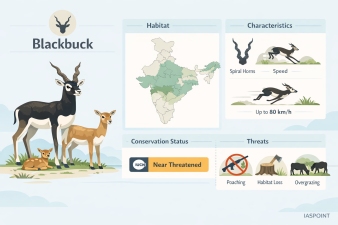
The Blackbuck (Antilope cervicapra), also known as the Indian Antelope, is the sole living species of the genus Antilope. It is considered one of the fastest land animals in India and is a flagship species for the conservation of open grasslands and scrub forests. It is deeply ingrained in Indian culture and mythology, often associated with the chariot of Lord Krishna and considered the vehicle (Vahana) of the moon god (Chandra).
Physical Characteristics and Sexual Dimorphism
Blackbucks exhibit striking differences between males and females, a trait known as sexual dimorphism.
- Males: Characterized by long, spiral horns (35–75 cm) that are ringed and diverge in a “V” shape. Their upper body turns dark brown to black as they mature, while the underparts and a ring around the eyes remain white.
- Females: Typically hornless (though some may develop small ones) and maintain a fawn or light brown coat throughout their lives.
- Behavior: They are diurnal and highly social, usually moving in herds of 15 to 50 individuals. They are known for their spectacular leaps (pronking) when startled.
Conservation Status and Legal Protection
The Blackbuck is a key species for UPSC Prelims due to its protected status and its presence in several conservation success stories.
| Framework | Status/Category |
| IUCN Red List | Least Concern (Population is increasing in India) |
| Wildlife Protection Act, 1972 | Schedule I (Highest Protection) |
| CITES | Appendix III (in Nepal) |
Distribution and Habitat
Blackbucks prefer open plains, grasslands, and semi-desert areas where they can utilize their speed to evade predators like the cheetah (now extinct in the wild in India) and wolves.
- Primary Range: Endemic to the Indian subcontinent; found in India, Nepal, and Pakistan.
- Key Habitats in India:
- Velavadar Blackbuck National Park (Gujarat): One of the most famous sites for sighting large herds.
- Tal Chhapar Sanctuary (Rajasthan): A critical grassland ecosystem in the Churu district.
- Point Calimere Wildlife Sanctuary (Tamil Nadu): A coastal habitat for the species.
- Guindy National Park (Tamil Nadu): One of the few national parks located within a city (Chennai).
- Abohar Wildlife Sanctuary (Punjab): A unique private sanctuary maintained by the Bishnoi community.
Cultural Significance: The Bishnoi Community
The conservation of Blackbucks is inextricably linked to the Bishnoi community of Rajasthan and Punjab.
- Philosophy: The Bishnois follow 29 tenets, one of which is the protection of all living beings and trees.
- Role: They have historically guarded Blackbucks against poachers, treating the animal as a sacred entity. This community-led protection is a primary reason for the survival of the species in non-protected agricultural landscapes.
Major Threats to Survival
- Habitat Fragmentation: Conversion of grasslands into agricultural lands and the expansion of linear infrastructure (roads, canals).
- Stray Dogs: Feral dogs have emerged as a primary predator for fawns in fragmented habitats.
- Invasive Species: The spread of Prosopis juliflora (Kabuli Kikar) reduces the availability of native grasses.
- Illegal Poaching: Historically hunted for their skin and horns, though legal protection has significantly reduced this.
Comparison: Blackbuck vs. Chinkara (Indian Gazelle)
Aspirants often confuse these two species found in similar semi-arid habitats.
| Feature | Blackbuck | Chinkara |
| Taxonomy | True Antelope (Antilope) | Gazelle (Gazella) |
| Horns | Long, spiral, “V” shaped | S-shaped, ribbed, shorter |
| Coat | Mature males are black/white | Sandy-fawn (both sexes) |
| Nostrils | No pre-orbital glands visible | Prominent pre-orbital glands |
Trivia for UPSC Prelims
- State Animal: The Blackbuck is the State Animal of Andhra Pradesh, Haryana, and Punjab.
- Speed: It is the second-fastest land animal in the world after the Cheetah, capable of reaching speeds of up to 80 km/hr.
- Population Trend: Unlike many Indian mammals, the Blackbuck population has seen a significant recovery in the last few decades due to strict enforcement of the Wildlife Protection Act and community support.
- Saline Tolerance: They can survive in saline areas and are often found in the Rann of Kutch.