
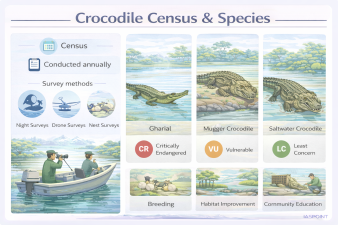
The annual crocodile census in India is typically conducted in January, coinciding with the winter season when reptiles bask in the sun, making them easier to count. The 2026 data highlights a period of significant growth and the 50th anniversary of the Indian Crocodile Conservation Project (1975–2025/26).
Bhitarkanika Saltwater Crocodile Census (2026)
Bhitarkanika National Park in Odisha remains the global stronghold for the Saltwater Crocodile (Crocodylus porosus).
- Total Count: 1,858 individuals (increase from 1,826 in 2025).
- Demographics: The 2026 census identified 531 hatchlings, 442 yearlings, 365 juveniles, 167 sub-adults, and 353 adults.
- White Crocodiles: Bhitarkanika is famous for its rare leucistic (white) crocodiles, including the famous “Gauri.”
- Range Expansion: Over 300 individuals were spotted outside the core park area, indicating a healthy but potentially conflict-prone population expansion into the rivers of Kendrapara.
Ganga Basin Gharial Survey (2026)
A landmark basin-wide survey conducted by the Wildlife Institute of India (WII) in early 2026 provided the most comprehensive data on the Critically Endangered Gharial (Gavialis gangeticus).
- Basin Count: Over 3,000 gharials were recorded across 13 rivers in the Ganga basin.
- Key Habitats: The National Chambal Sanctuary (shared by MP, UP, and Rajasthan) remains the primary breeding hub, followed by the Gandak and Girwa rivers.
- Population Milestone: This is the highest count recorded since systematic monitoring began, showing a slow recovery from the near-extinction levels of the 1970s.
Mugger Crocodile Census: Vishwamitri River (2026)
The Mugger or Marsh Crocodile (Crocodylus palustris) is the most widespread species in India, with a notable urban population in Gujarat.
- Vishwamitri Survey: Conducted by the Gujarat Forest Department in February 2026.
- Urban Coexistence: The survey focused on an 18 km stretch in Vadodara city, highlighting one of the densest urban crocodile populations globally.
- Status: While widespread (found in 15+ states), the Mugger remains “Vulnerable” due to habitat fragmentation and human-animal conflict in states like Gujarat and Tamil Nadu.
Comparative Species Analysis for UPSC Prelims
| Feature | Gharial | Mugger (Marsh) | Saltwater (Estuarine) |
| Scientific Name | Gavialis gangeticus | Crocodylus palustris | Crocodylus porosus |
| IUCN Status | Critically Endangered | Vulnerable | Least Concern |
| CITES Status | Appendix I | Appendix I | Appendix I (except Aus/Indon) |
| Primary Diet | Only Fish (Piscivorous) | Generalist (Birds, Mammals) | Apex Predator (Opportunistic) |
| Unique Trait | Ghara (knob) on male snout | Broadest snout | Largest living reptile |
| Key Location | Chambal River | Vishwamitri River | Bhitarkanika / Sundarbans |
Threats and Conservation Challenges in 2026
Despite rising numbers, environmental and administrative shifts pose new risks.
- Habitat Denotification: In January 2026, the Rajasthan government approved the denotification of ~732 hectares of the National Chambal Sanctuary to resolve land revenue overlaps, raising concerns about increased sand mining in those stretches.
- Illegal Sand Mining: Remains the #1 threat to Gharials, as it destroys the high sandbanks required for nesting.
- Bycatch: Entanglement in nylon fishing nets continues to be a leading cause of accidental mortality for all three species.
- Conflict: Rising populations in Bhitarkanika and Vadodara have led to an increase in human-crocodile encounters, necessitating tech-based monitoring (drones and AI-assisted cameras).
Trivia for Quick Revision
- Odisha’s Triple Crown: Odisha is the only Indian state where all three species (Gharial, Mugger, Saltwater) are found.
- Kendrapara’s Record: Kendrapara is the only district in India housing all three species.
- Indicator Species: The Gharial is a biological indicator of clean river water.
- Rear-and-Release: This technique, where eggs are hatched in labs and juveniles released once they are 1 meter long, is the backbone of the 1975 Project.