
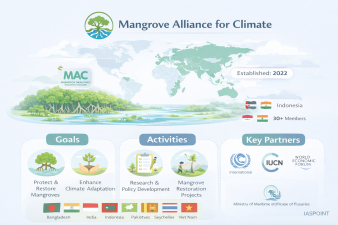
The Mangrove Alliance for Climate (MAC) is an intergovernmental initiative launched to scale up and accelerate the conservation and restoration of mangrove ecosystems globally. Introduced at the 27th Conference of Parties (COP27) to the UNFCCC held in Sharm el-Sheikh, Egypt, in 2022, the alliance positions mangroves as a critical nature-based solution to climate change. Unlike some international treaties, MAC is a voluntary alliance, allowing member nations to set their own targets for mangrove plantation and restoration without legally binding commitments.
Founding and Membership
The initiative was spearheaded by the United Arab Emirates (UAE) and Indonesia. Its membership has since grown to include several key maritime and ecological stakeholders.
- Lead Partners: UAE and Indonesia.
- Key Members: India, Sri Lanka, Australia, Japan, Spain, and more recently, nations like Sierra Leone and Norway.
- India’s Involvement: India joined MAC at COP27 (November 2022), aligning the alliance’s goals with its own Nationally Determined Contributions (NDCs) under the Paris Agreement.
Core Objectives and Functions
The alliance operates on the premise that global cooperation is essential for maintaining “Blue Carbon” sinks.
- Global Awareness: Educating the international community on the role of mangroves in climate change mitigation and adaptation.
- Technical Cooperation: Facilitating the exchange of scientific research, management expertise, and best practices among member nations.
- Restoration Commitment: Encouraging members to plant and rehabilitate mangroves within their borders to enhance coastal resilience.
- Policy Integration: Supporting the inclusion of mangrove conservation in international climate policy dialogues and national development plans.
Ecological Significance: The “Blue Carbon” Potential
Mangroves are among the most carbon-rich ecosystems on the planet, making them central to the “Blue Carbon” strategy.
| Feature | Comparison & Facts |
| Sequestration Rate | Mangroves can sequester carbon up to 4 to 10 times faster than terrestrial tropical forests. |
| Storage Capacity | They store significant amounts of carbon in their peaty soils and biomass, keeping it out of the atmosphere for centuries. |
| Global Area | Although they cover less than 0.1% of Earth’s surface, they are vital for coastal biodiversity. |
| Bio-shield Effect | They act as a natural defense, reducing wave energy by 60% to 90% during storm surges and cyclones. |
India’s Strategic Role and Domestic Initiatives
India possesses roughly 3% of South Asia’s total mangrove cover and has become a vocal advocate for integrating mangroves into the REDD+ (Reducing Emissions from Deforestation and Forest Degradation) framework.
The MISHTI Scheme
Launched in the Union Budget 2023-24, the Mangrove Initiative for Shoreline Habitats & Tangible Incomes (MISHTI) is India’s primary domestic vehicle for achieving MAC objectives.
- Scope: Covers nearly 540 sq. km across 11 States and 2 Union Territories.
- Funding: Primarily through CAMPA (Compensatory Afforestation Fund Management and Planning Authority) funds and MGNREGS.
- Objective: To share best practices on plantation techniques and conservation while creating sustainable livelihood opportunities for local communities.
Key Indian Mangrove Zones
- Sundarbans (West Bengal): The largest contiguous mangrove forest in the world and the only mangrove habitat for tigers.
- Gujarat (Gulf of Kutch/Khambhat): Home to the second-largest mangrove cover in India, showing significant growth in recent years.
- Pichavaram (Tamil Nadu): One of the world’s most unique mangrove ecosystems, functioning as a vital nursery for marine life.
Comparison with Global Mangrove Alliance (GMA)
While MAC is an intergovernmental, policy-driven alliance, it often works in synergy with the Global Mangrove Alliance (GMA).
- MAC: Focuses on intergovernmental cooperation, voluntary state commitments, and high-level climate diplomacy (COP-centric).
- GMA: A collaboration between NGOs (like WWF, IUCN, CI) and scientists with a specific technical goal: to increase the global mangrove area by 20% by 2030.
- The Mangrove Breakthrough: A joint initiative launched at COP27 by GMA and UN Climate Change High-Level Champions to secure $4 billion in funding to protect and restore 15 million hectares of mangroves.