

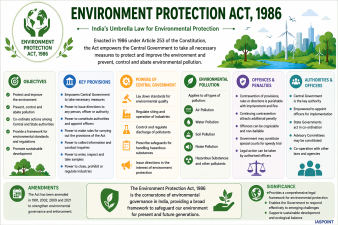
The Environment (Protection) Act (EPA), 1986 is often referred to as “Umbrella Legislation” because it provides a comprehensive framework for the coordination of various central and state authorities established under previous laws, such as the Water Act and the Air Act. Enacted under Article 253 of the Constitution, it empowers the Parliament to enact laws for implementing international agreements—specifically the 1972 United Nations Conference on the Human Environment (Stockholm Conference).
The Bhopal Gas Tragedy Connection
The EPA was born out of the immediate aftermath of the Bhopal Gas Tragedy (1984). The disaster highlighted the inadequacies of existing environmental laws, prompting the government to create a robust legislative tool to handle industrial hazardous wastes and environmental emergencies.
Key Provisions and Powers of the Central Government
Under the EPA, the Central Government possesses extensive powers to take all necessary measures to protect and improve the quality of the environment.
- Standard Setting: The government can lay down standards for the quality of environment in its various aspects and for the emission or discharge of environmental pollutants.
- Restriction of Areas: It has the authority to restrict areas in which any industries, operations, or processes shall not be carried out, or shall be carried out subject to certain safeguards (Eco-Sensitive Zones).
- Handling Hazardous Substances: The Act provides the power to lay down procedures and safeguards for the handling of hazardous substances to prevent accidents.
- Entry and Inspection: Any person empowered by the Central Government has the right to enter and inspect any place for the purpose of performing functions entrusted under the Act.
- Sample Collection: Authorities can take samples of air, water, soil, or other substances from any factory or premises for analysis.
Environment Impact Assessment (EIA)
The most significant regulatory tool derived from the EPA is the Environment Impact Assessment.
- Statutory Basis: The EIA process is a set of procedures established under the EPA to evaluate the potential environmental impacts of a proposed project or development.
- Notification: The first EIA notification was issued in 1994, later replaced by a more comprehensive one in 2006.
- Process: It involves screening, scoping, public consultation, and appraisal. It ensures that “precautionary principles” are applied before any major industrial or infrastructure project begins.
Genetic Engineering Appraisal Committee (GEAC)
Established under the “Rules for Manufacture, Use, Import, Export and Storage of Hazardous Micro-organisms/Genetically Engineered Organisms or Cells, 1989” (framed under the EPA), the GEAC is the apex body in India for regulating Genetically Modified (GM) crops.
- Role: It is responsible for the appraisal of proposals relating to the release of genetically engineered organisms and products into the environment, including experimental field trials.
- Authority: No GM crop (like Bt Cotton or GM Mustard) can be commercially released in India without GEAC approval.
Eco-Sensitive Zones (ESZs)
While the term “Eco-Sensitive Zone” is not explicitly mentioned in the EPA, Section 3(2)(v) of the Act gives the Central Government the power to restrict industrial operations in sensitive areas.
- Objective: ESZs act as “shock absorbers” for protected areas (National Parks and Sanctuaries) by regulating and managing activities around them.
- Extent: Usually, an area up to 10 kilometers around a protected area is notified as an ESZ, though this can vary based on ecological significance.
Penalties and Compliance
The EPA follows a strict penalty regime to ensure environmental discipline.
- General Penalties: Failure to comply with the Act can result in imprisonment for a term up to 5 years, a fine up to ₹1 lakh, or both.
- Continuing Offence: If the failure continues, an additional fine of ₹5,000 per day can be imposed. If the failure continues beyond one year after conviction, the offender can be imprisoned for up to 7 years.
- Corporate and Government Liability: If an offense is committed by a company or a government department, the Head of the Department or the person in charge is deemed guilty unless they prove the offense took place without their knowledge.
Comparison: Water Act, Air Act, and EPA
| Feature | Water Act (1974) | Air Act (1981) | Environment Act (1986) |
| Scope | Specifically Water Pollution | Specifically Air Pollution | Entire Environment (Air, Water, Land) |
| Authority | SPCB / CPCB | SPCB / CPCB | Central Government (Umbrella) |
| Power to Close Industry | Requires Court Order (Initially) | Requires Court Order (Initially) | Direct Power to Close/Regulate |
| Focus | Pollution Control | Pollution Control | Holistic Management & EIA |
Important Rules Framed under EPA
The EPA acts as the parent legislation for various specialized environmental rules in India:
- Coastal Regulation Zone (CRZ) Notification: Regulates activities in coastal areas to protect marine ecosystems.
- Hazardous Waste Management Rules: Governs the generation, storage, and disposal of hazardous materials.
- Municipal Solid Waste Rules: Provides guidelines for the management of urban waste.
- Ozone Depleting Substances (Regulation and Control) Rules: Implemented to fulfill India’s obligations under the Montreal Protocol.
Trivia for UPSC Prelims
- Public Participation: The EPA allows any person to file a complaint in court regarding the violation of the Act, provided they have given a notice of 60 days to the government authority.
- Precautionary Principle: The Supreme Court of India has interpreted the EPA as the legal embodiment of the “Precautionary Principle” and the “Polluter Pays Principle.”
- Constitutional Link: The EPA is a landmark example of the use of Article 253, where the Union makes laws on state subjects (like public health or agriculture) to honor international treaties.