
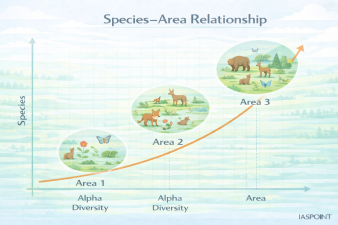
The Species–Area Relationship is a fundamental principle in ecology that quantifies how the number of species found in a defined geographical area increases as the size of that area increases. This concept is crucial for understanding biodiversity patterns, island biogeography, and the impact of habitat loss.
Historical Context: Alexander von Humboldt
The relationship was first systematically observed by the German naturalist and explorer Alexander von Humboldt. During his extensive explorations in the South American jungles, he noted that within a specific region, species richness increases with increasing explored area, but only up to a certain limit.
Mathematical Representation
On a global scale, the relationship between species richness and area for a wide variety of taxa (angiosperm plants, birds, bats, freshwater fishes) turns out to be a rectangular hyperbola.
The Equation
When plotted on a logarithmic scale, the relationship becomes linear and is described by the following equation:
- S = Species richness (Number of species)
- A = Area
- Z = Slope of the line (regression coefficient)
- C = Y-intercept
The Significance of the Slope (Z)
The value of Z (the slope) is a critical indicator of how rapidly species richness increases with area.
- Uniformity in Small Areas: Ecologists have discovered that the value of Z lies in the range of $0.1$ to $0.2$, regardless of the taxonomic group or the region (e.g., plants in Britain or birds in California).
- Steep Slopes in Large Areas: If the species-area relationship is analyzed across very large areas (like entire continents), the slope of the line becomes much steeper, with Z values ranging from $0.6$ to $1.2$.
- Frugivorous Birds and Mammals: In tropical forests across different continents, the slope for fruit-eating birds and mammals is often found to be $1.15$, indicating a high rate of species turnover over larger areas.
Factors Influencing the Relationship
| Factor | Impact on Species Richness |
| Habitat Diversity | Larger areas typically encompass a wider variety of habitats and niches, supporting more species. |
| Colonization Rate | Larger areas provide a bigger “target” for immigrating species. |
| Extinction Rate | Larger areas support larger populations, which are less prone to accidental extinction. |
| Speciation | Over evolutionary timescales, larger areas provide more opportunities for reproductive isolation and speciation. |
Application in Conservation Biology
1. Island Biogeography
The SAR is the backbone of the Theory of Island Biogeography (MacArthur and Wilson). It explains why larger islands near a mainland have higher biodiversity than small, isolated islands.
2. Habitat Fragmentation
The relationship helps scientists predict how many species will be lost if a habitat is reduced by a certain percentage. For example, if 90% of a habitat is destroyed, the SAR predicts that roughly 50% of the species residing there will eventually go extinct.
3. Designing Protected Areas
The concept informs the SLOSS Debate (Single Large Or Several Small). It generally suggests that a single large protected area is better for preserving species richness than several small areas of the same total size, as the large area can support interior species that avoid “edges.”
UPSC Prelims Trivia: The “Species-Area Curve”
- The Curve: It is a Rectangular Hyperbola on a normal coordinate system.
- The Log-Log Plot: It is a Straight Line on a logarithmic scale.
- Saturation Point: The curve eventually flattens out because, at a certain point, all possible species in the regional pool have been sampled, and increasing the area further does not add new species.