

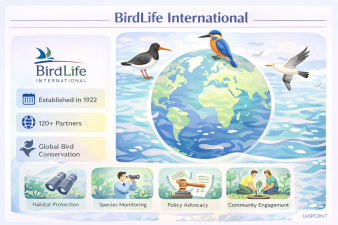
BirdLife International is the world’s largest nature conservation partnership, consisting of a global network of non-governmental organizations (NGOs) that strive to conserve birds, their habitats, and global biodiversity.
Institutional Profile and History
Foundation and Structure
- Establishment: Founded in 1922 as the International Council for Bird Preservation (ICBP). It was renamed BirdLife International in 1993.
- Headquarters: Cambridge, United Kingdom.
- Nature: It is a global partnership of over 115 national NGOs (one per country/territory).
- Indian Partner: The Bombay Natural History Society (BNHS) is the designated partner of BirdLife International in India.
Role as a Red List Authority
BirdLife International is the official Red List Authority for birds for the IUCN Red List. It assesses the conservation status of all the world’s bird species (approximately 11,000 species) to determine their risk of extinction.
Core Conservation Frameworks
Important Bird and Biodiversity Areas (IBAs)
IBAs are places of international significance for the conservation of birds and other biodiversity. They are identified based on a set of standardized, internationally agreed-upon criteria:
- A1 (Globally Threatened Species): Sites regularly holding significant numbers of a globally threatened species.
- A2 (Restricted-Range Species): Sites supporting species with a breeding range of less than 50,000 sq. km.
- A3 (Biome-Restricted Species): Sites supporting a set of species whose distribution is largely or wholly confined to a particular biome.
- A4 (Congregations): Sites holding exceptionally large numbers of migratory or congregatory birds (e.g., 1% of a global population).
Endemic Bird Areas (EBAs)
An EBA is an area where two or more “restricted-range” bird species are entirely confined. Identifying EBAs helps prioritize global conservation efforts in regions with high concentrations of unique species.
Key Programs and Strategic Initiatives
| Program | Objective | Key Focus Area |
| Preventing Extinctions | To halt the extinction of bird species. | Focuses on “BirdLife Species Guardians” (local experts) and “Species Champions” (donors). |
| Flyways Programme | Protecting migratory birds across their entire journey. | Focuses on major routes like the East Asian-Australasian Flyway and the Central Asian Flyway (relevant to India). |
| Marine Programme | Conserving seabirds and marine ecosystems. | Addressing threats like bycatch in longline and gillnet fisheries. |
| Forests of Hope | Managing and restoring tropical forest landscapes. | Protecting sites that provide critical ecosystem services and carbon storage. |
Flagship Publication: State of the World’s Birds
BirdLife International publishes the State of the World’s Birds report, which provides a comprehensive look at the health of bird populations globally.
- Current Status (2026 Context): Nearly half of all bird species are currently in decline.
- Threat Factors: The report identifies industrial agriculture, logging, invasive species, and climate change as the primary drivers of avian decline.
- Indicator Species: Birds are considered excellent indicators of environmental health because they are highly sensitive to habitat changes and easy to monitor.
BirdLife International in India
Collaboration with BNHS
As the Indian partner, BNHS implements the IBA program in India. India currently has over 550 identified IBAs, including:
- Keoladeo National Park (Rajasthan): A major wintering ground for Palaearctic migratory waterfowl.
- Chilika Lake (Odisha): A critical site for congregatory waterbirds.
- Pulicat Lake (Andhra Pradesh/Tamil Nadu): Famous for Greater Flamingos.
Vulture Conservation
BirdLife International and BNHS have been instrumental in the campaign to ban Diclofenac, a veterinary drug that caused a catastrophic 99% decline in South Asian vulture populations. They established Vulture Safe Zones (VSZs) and conservation breeding centers to prevent the extinction of the White-rumped, Slender-billed, and Indian Vultures.
Essential Trivia for UPSC Prelims
- Avian Taxonomy: In 2025, BirdLife adopted the AviList as its global avian taxonomy standard to ensure scientific consistency across the partnership.
- World Migratory Bird Day: BirdLife is a key partner in this global awareness campaign, celebrated twice a year (second Saturday of May and October).
- Status vs. Listing: While BirdLife identifies IBAs, the sites do not automatically get legal protection. It is the responsibility of the respective national governments to designate them as Protected Areas (National Parks or Sanctuaries).
- Largest Partner: The RSPB (Royal Society for the Protection of Birds) in the UK is the largest partner within the BirdLife network.