

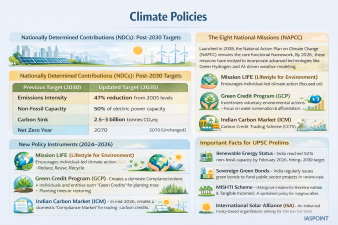
India’s climate policy is built on a “pro-growth, pro-planet” philosophy, transitioning from voluntary commitments to a more rigorous, legally backed institutional framework. As of 2026, the policy landscape is defined by the updated Nationally Determined Contributions (NDCs) for the 2031-2035 period and the institutionalization of carbon markets.
Nationally Determined Contributions (NDCs): Post-2030 Targets
| Parameter | Previous Target (2030) | Updated Target (2035) |
| Emissions Intensity | 45% reduction from 2005 levels | 47% reduction from 2005 levels |
| Non-Fossil Capacity | 50% of electric power capacity | 60% of electric power capacity |
| Carbon Sink | 2.5–3 billion tonnes CO2eq | 3.5–4 billion tonnes CO2eq |
| Net Zero Year | 2070 | 2070 (Unchanged) |
The Eight National Missions (NAPCC)
Launched in 2008, the National Action Plan on Climate Change (NAPCC) remains the core functional framework. By 2026, these missions have evolved to incorporate advanced technologies like Green Hydrogen and AI-driven weather modeling.
- National Solar Mission: Target expanded beyond 100 GW; focus shifted to “PM Surya Ghar: Muft Bijli Yojana” for residential rooftop solar.
- National Mission for Enhanced Energy Efficiency (NMEEE): Governs the PAT (Perform, Achieve and Trade) scheme, which now covers over 13 energy-intensive sectors including Railways and DISCOMs.
- National Mission on Sustainable Habitat: Focuses on the Energy Conservation Building Code (ECBC) and the transition to Electric Vehicles (FAME scheme).
- National Water Mission: Implementation of “Jal Shakti Abhiyan” for 20% improvement in water-use efficiency.
- National Mission for Sustaining the Himalayan Ecosystem: Dedicated to monitoring 9,000+ glaciers and preventing GLOFs.
- National Mission for a Green India: Aims for afforestation of 5 million hectares; now integrated with the Green Credit Program.
- National Mission for Sustainable Agriculture: Promotes organic farming and “Per Drop More Crop” micro-irrigation.
- National Mission on Strategic Knowledge: Focuses on climate modeling and international research collaborations.
New Policy Instruments (2024–2026)
India has introduced specialized programs to drive behavioral change and market-based solutions.
Mission LiFE (Lifestyle for Environment)
Introduced at COP26, this policy encourages individual-led climate action. It focuses on circular economy principles, such as “Reduce, Reuse, Recycle,” and has been integrated into school curricula and government procurement policies.
Green Credit Program (GCP)
Launched under the Environment (Protection) Act, the GCP is an innovative market-based mechanism to incentivize voluntary environmental actions.
- Primary Focus: Initially targets water conservation and afforestation.
- Mechanism: Individuals and entities can earn “Green Credits” for planting trees on degraded land or restoring water bodies.
- Fungibility: These credits are distinct from Carbon Credits but provide a verifiable metric for ESG (Environmental, Social, and Governance) compliance.
Indian Carbon Market (ICM)
By mid-2026, India finalized the Carbon Credit Trading Scheme (CCTS). This creates a domestic “Compliance Market” where obligated entities (like power plants) must meet emission reduction targets or purchase credits from the market.
Legal and Regulatory Updates (2026)
- Solid Waste Management Rules 2026: Replaced the 2016 rules, mandating 100% remediation of legacy landfills (e.g., Ghazipur, Bhalswa) and introducing stricter “Bulk Waste Generator” definitions.
- Plastic Waste Management (Amendment) Rules 2026: Mandates that rigid plastic packaging must contain at least 30% recycled material, scaling to 60% by 2029.
- Energy Conservation (Amendment) Act: Empowers the government to specify a “Carbon Credit Trading Scheme” and mandates the use of non-fossil sources for energy and feedstock in industries.
Important Facts for UPSC Prelims
- Renewable Energy Status: India reached 52% non-fossil capacity by February 2026, hitting its 2030 target four years early.
- Sovereign Green Bonds: India regularly issues green bonds to fund public sector projects in renewable energy and clean transport, reducing the cost of capital for green projects.
- MISHTI Scheme: (Mangrove Initiative for Shoreline Habitats & Tangible Incomes) A specialized policy for mangrove afforestation along India’s coastline and salt pans.
- International Solar Alliance (ISA): An Indian-led treaty-based organization headquartered in Gurugram, aiming for “One Sun, One World, One Grid” (OSOWOG).