
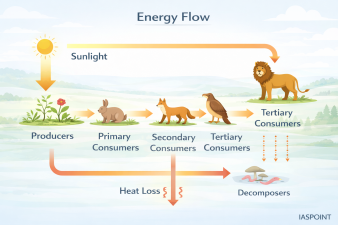
Energy flow is the most vital functional process of an ecosystem. It involves the transfer of energy from the external environment (primarily the Sun) through various living organisms and its eventual dissipation as heat. Unlike nutrients, which cycle through the system, energy follows a unidirectional (one-way) path.
Thermodynamic Governance
Energy flow is strictly governed by the two Laws of Thermodynamics:
- First Law: Energy is neither created nor destroyed but transformed. In ecosystems, solar energy is converted into chemical energy (organic matter) by producers.
- Second Law: During every energy transformation, a portion of energy is dissipated as unusable heat. This increases the “entropy” or disorder of the system. Consequently, ecosystems require a constant influx of solar energy to maintain their organized structure.
The Process of Energy Transfer
The movement of energy occurs through the feeding relationships established in food chains and webs.
Primary Energy Capture
- Photosynthetically Active Radiation (PAR): Of the total incident solar radiation, less than 50% is PAR.
- Capture Efficiency: Plants capture only 2–10% of the PAR to sustain the entire living world.
- Gross Primary Productivity (GPP): The total energy fixed by plants.
Trophic Transfer and the 10% Law
Energy is transferred from one trophic level to the next. Raymond Lindeman’s 10% Law states that only approximately 10% of the energy available at one trophic level is transferred to the next.
- Losses: 90% of the energy is lost through:
- Respiration: Energy used for metabolic activities.
- Heat: Dissipation during chemical reactions.
- Incomplete Digestion: Energy lost in feces and waste.
Patterns of Energy Flow
Energy enters the biotic community through two distinct but interconnected pathways.
| Feature | Grazing Food Chain (GFC) | Detritus Food Chain (DFC) |
| Source | Solar Energy → Living Plants | Chemical Energy → Dead Organic Matter |
| Initial Level | Primary Producers | Decomposers/Detritivores |
| Ecosystem Dominance | Major conduit in Aquatic ecosystems. | Major conduit in Terrestrial ecosystems. |
Pyramid of Energy
The Pyramid of Energy is a graphical representation of the amount of energy present at each trophic level per unit area and time.
- Shape: It is always upright. It can never be inverted or spindle-shaped.
- Reason: Because energy is lost as heat at each transfer (2nd Law of Thermodynamics), the energy available to the next level is always less than the level below it.
- Implication: This explains why top predators (like Tigers or Eagles) are few in number; the ecosystem cannot provide enough energy to support a large population of apex consumers.
Key Terms for UPSC Prelims
- Trophic Level: The functional position of an organism in a food chain.
- Ecological Efficiency: The ratio of energy received by a trophic level to the energy received by the preceding trophic level.
- Energy Subsidy: External energy inputs (like fertilizers in agriculture or tide energy in estuaries) that increase the productivity of an ecosystem beyond its natural solar limits.
- Universal Model of Energy Flow: E.P. Odum’s model which illustrates that as energy flows through a system, it progressively declines, but the “quality” or concentration of energy (energy per unit biomass) increases at higher trophic levels.
Ecological Implications
- Bioenergetics: The study of how energy flows through living systems.
- Stability: Ecosystems with more complex energy pathways (Food Webs) are generally more stable than those with simple linear pathways.
- Anthropogenic Impact: Human activities like deforestation reduce the “base” of the energy pyramid, causing a collapse in the energy available for higher trophic levels and leading to biodiversity loss.