
Mangroves are salt-tolerant plant communities found in tropical and subtropical intertidal regions. In India, they represent a critical “Blue Carbon” ecosystem, covering approximately 4,992 sq. km (about 0.15% of the country’s total geographical area).
Key Adaptations for Survival
Mangroves have evolved unique physiological and morphological traits to thrive in saline, waterlogged, and anaerobic (oxygen-poor) soils:
- Pneumatophores: Upward-growing “breathing roots” that facilitate gas exchange in oxygen-deficient mud.
- Vivipary: A unique reproduction method where seeds germinate while still attached to the parent tree; the seedling (propagule) drops only when it is ready to take root.
- Salt Management:
- Exclusion: Some species (e.g., Rhizophora) use a waxy root layer to filter out up to 90% of salt.
- Excretion: Other species (e.g., Avicennia) possess specialized glands on leaves to secrete excess salt.
- Stilt and Buttress Roots: Provide structural stability against heavy wave action and shifting tides.
Distribution and Regional Variations
India’s mangrove distribution is highly heterogeneous, with a marked difference between the East and West coasts.
| State/UT | Share (%) | Key Characteristics |
| West Bengal | ~42.5% | Home to the Sundarbans, the largest contiguous mangrove forest globally and the only one with tigers. |
| Gujarat | ~23.3% | Second largest cover; primarily found in the Gulf of Kutch and Gulf of Khambhat. |
| A&N Islands | ~12.2% | Boasts high species diversity and pristine patches. |
| Andhra Pradesh | ~8.1% | Notable areas include Coringa Wildlife Sanctuary (Godavari Delta). |
Statutory and Policy Framework
Mangrove conservation in India is supported by multiple layers of legislation and targeted central schemes.
Regulatory Protection
- CRZ Notification (2019): Mangroves are classified under CRZ-IA (Ecologically Sensitive Areas), providing them the highest level of protection against developmental activities.
- Wildlife (Protection) Act, 1972: Many mangrove areas are part of National Parks or Sanctuaries.
- Replantation Mandate: If mangroves are cleared for vital developmental projects, compensatory replantation must be done at a 3:1 ratio.
The MISHTI Scheme (2023–2028)
Launched to align with the global Mangrove Alliance for Climate (MAC), this scheme aims to restore 540 sq. km of mangroves.
- Convergence Model: Uses 80% funding from CAMPA and 20% from MGNREGS.
- 2026 Milestone: Gujarat has emerged as the top performer, providing nearly 85% of the land acquired under the scheme so far.
Significant Organizations and Models
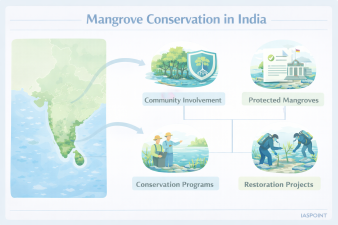
- M.S. Swaminathan Research Foundation (MSSRF): Pioneered the Joint Mangrove Management (JMM) model, which integrates science-based restoration with community livelihoods.
- Integrated Mangrove Fishery Farming System (IMFFS): A model where fish/shrimp farming is combined with mangrove plantation to ensure ecological and economic sustainability.
- Magellanic Cloud/Tech Integration: Since 2025, India has increased the use of AI and drone-based monitoring to track the survival rates of saplings in deep deltaic regions.
Facts and Trivia for Prelims
- Sundari Tree (Heritiera fomes): The namesake species of the Sundarbans; it is currently threatened by increasing salinity.
- Carbon Sink: Mangroves store 4 to 10 times more carbon per hectare than typical terrestrial tropical forests, mostly in their deep soil.
- Bio-Shield: During the 2004 Tsunami and recent cyclones like Amphan and Remal, areas with thick mangrove cover experienced significantly less inland damage.
- Pichavaram (Tamil Nadu): One of the largest mangrove forests in India, famous for its intricate network of waterways