
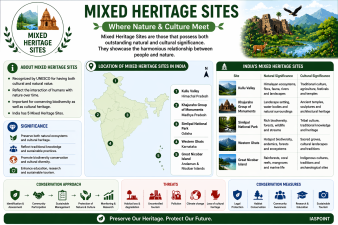
Mixed Heritage Sites are properties that satisfy the UNESCO definition of both Cultural and Natural Heritage as per the 1972 World Heritage Convention. These sites represent a unique synthesis of biological or geological significance alongside exceptional human interaction, spiritual traditions, or historical artifacts.
- Dual Assessment: A site must meet at least one cultural criterion (i-vi) and at least one natural criterion (vii-x) to be categorized as “Mixed.”
- Global Context: Globally, mixed sites are the rarest category of World Heritage Sites, as it is difficult to prove “Outstanding Universal Value” (OUV) across both disciplines simultaneously.
- India’s Standing: As of April 2026, India possesses one Mixed World Heritage Site: Khangchendzonga National Park.
Khangchendzonga National Park (KNP)
Inscribed in 2016, this site is located in the Himalayan state of Sikkim. It is the first and only mixed site in India.
Natural Significance (Criteria vii and x)
- Altitudinal Range: The park exhibits one of the widest altitudinal ranges in the world, stretching from sub-tropical forests at 1,220 meters to the high alpine zone and permanent snow at over 8,500 meters.
- Peak Kanchenjunga: It contains Mount Kanchenjunga, the third-highest peak in the world.
- Glaciology: The site features the massive Zemu Glacier, one of the largest in the Eastern Himalayas.
- Biodiversity: It is a part of the Himalaya Biodiversity Hotspot, home to the Snow Leopard, Red Panda, Himalayan Musk Deer, and the Asiatic Black Bear.
Cultural Significance (Criteria iii and vi)
- Sacred Landscape: For the indigenous Lepcha people, the landscape is a “Mayel Lyang” (Hidden Land). For Buddhists, it is a Beyul (Sacred Hidden Land), specifically Demoshong.
- Spiritual Integration: The physical features of the mountains, caves, and lakes are integrated with ancient religious texts and rituals. It is considered the core of the Sikkimese identity.
- Gompas: The park buffer zone contains several ancient monasteries (Gompas), including the Tholung Monastery, which preserves the sacred artifacts of Sikkim’s history.
Summary Table of Khangchendzonga NP
| Feature | Details |
| Location | Sikkim, India (North and West districts) |
| Year of Inscription | 2016 |
| Highest Point | Mt. Kanchenjunga (8,586 m) |
| Flagship Fauna | Snow Leopard, Red Panda, Blood Pheasant |
| Spiritual Concept | Beyul (Hidden Sacred Valley) |
| River System | Teesta River (headwaters located here) |
Potential Mixed Sites on India’s Tentative List
While India only has one inscribed mixed site, several sites on the UNESCO Tentative List are being considered for mixed status due to their dual values:
- Muziris Heritage Precinct (Kerala): Combines the ancient maritime silk route history with the unique backwater wetland ecosystem.
- Apatani Cultural Landscape (Arunachal Pradesh): Recognized for the Ziro Valley’s unique agro-ecosystem (fish-cum-paddy culture) and the distinct social structure of the Apatani tribe.
- Cold Desert Cultural Landscape (Ladakh/HP): Focuses on high-altitude survival techniques, ancient monasteries (Hemis, Thiksey), and rare fauna like the Tibetan Gazelle.
Comparison with Other Categories
| Category | Primary Focus | Examples in India |
| Cultural | Human creative genius, monuments, urban design. | Taj Mahal, Dholavira, Hampi. |
| Natural | Geological processes, biological evolution, habitat. | Kaziranga, Western Ghats, Sundarbans. |
| Mixed | Indivisible link between nature and culture. | Khangchendzonga National Park. |
Trivia for UPSC Prelims
- UNESCO Mixed Sites Worldwide: Out of 1,199+ sites globally (as of recent counts), only about 39 are mixed sites.
- KNP Buffer Zone: The buffer zone of KNP includes the Sikkim’s First Capital, Yuksom, and the famous trekking route to Goechala.
- The “Hidden Land”: The term Beyul refers to a place that can only be accessed by those with a high level of spiritual realization, a concept central to the cultural OUV of KNP.