

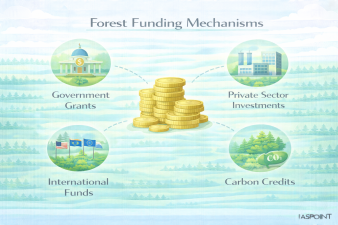
Forest funding mechanisms in India have evolved from simple budgetary allocations to sophisticated, market-based, and statutory financial structures.
Statutory and Domestic Funding Mechanisms
India utilizes a mix of statutory funds and budgetary schemes to finance forest conservation and afforestation.
Compensatory Afforestation Fund (CAF) & CAMPA
The most significant domestic source of forest funding is governed by the Compensatory Afforestation Fund Act, 2016.
- Source of Funds: Money collected from user agencies (industries/projects) for “diverting” forest land for non-forest use. This includes the Net Present Value (NPV) of the forest, costs of compensatory afforestation, and wildlife management plans.
- The 90:10 Rule: 90% of the funds are transferred to the State Compensatory Afforestation Fund, while 10% is retained in the National Compensatory Afforestation Fund (kept in the Public Account of India).
- Utilization: Funds are non-lapsable and are used for assisted natural regeneration, forest fire prevention, and pest control. As of 2026, a major focus has shifted towards the GIS-based digitization of forest boundaries to ensure transparency.
National Adaptation Fund for Climate Change (NAFCC)
Established in 2015, this central sector scheme provides 100% grants to states for climate adaptation.
- Implementation: Managed by NABARD (National Bank for Agriculture and Rural Development) as the National Implementing Entity.
- Forest Linkage: Funding is provided for projects in vulnerable states that focus on forestry, water, and biodiversity as tools for climate resilience.
Market-Based and Innovative Financing
Recent policy shifts have introduced market dynamics to incentivize conservation through “credits” and private participation.
Green Credit Programme (GCP)
Launched under the LiFE (Lifestyle for Environment) movement, the GCP is an innovative market-led mechanism.
- Mechanism: Entities (NGOs, private firms, individuals) earn “Green Credits” for voluntary environmental actions like tree plantation on degraded forest lands.
- Land Bank: The government maintains a digital inventory of degraded forest lands available for afforestation by participants.
- Interchangeability: As of 2026, a framework exists for the potential exchange of Green Credits with Carbon Credits, provided the activity leads to verifiable carbon sequestration.
Green India Mission (GIM)
One of the eight missions under the National Action Plan on Climate Change (NAPCC).
- Funding: Receives budgetary support through the Ministry of Environment, Forest and Climate Change (MoEFCC).
- Objective: Aiming to protect, restore, and enhance India’s diminishing forest cover and respond to climate change by a combination of adaptation and mitigation measures.
International Funding and Multilateral Mechanisms
India accesses several global windows to fund large-scale landscape restoration and biodiversity conservation.
| Mechanism | Description | Role in India |
|---|---|---|
| Global Environment Facility (GEF) | Financial mechanism for five major international environmental conventions (including CBD and UNCCD). | Supports projects on “Sustainable Land Management” and “Biodiversity Conservation” in the Western Ghats and Himalayas. |
| Green Climate Fund (GCF) | Largest global fund dedicated to climate change under the UNFCCC. | Funds India’s projects related to coastal mangrove restoration and resilient forestry. |
| REDD+ (Reducing Emissions from Deforestation and Forest Degradation) | An international framework that provides financial incentives to developing countries to reduce emissions from forested lands. | India’s National REDD+ Strategy utilizes these principles to gain international support for maintaining and increasing forest carbon stocks. |
Budgetary Landscape (2026-27)
The fiscal year 2026-27 reflects India’s updated priorities in environmental spending.
- Allocation: The MoEFCC was allocated approximately ₹3,759 crore, representing a 7% to 10% increase over previous years.
- Priority Shift: Significant funds are being diverted toward AI-driven forest fire prevention and Control of Pollution schemes.
- Utilization Challenge: Parliamentary reports highlight a trend where nearly 30-35% of allocated funds in the forestry sector often remain underutilized by states, leading to recommendations for more streamlined release mechanisms.
UPSC Trivia: Financial Terms to Know
- Net Present Value (NPV): The economic value of a forest’s ecosystem services over 50 years. In 2026, NPV rates are periodically updated to reflect the rising value of carbon and water services.
- Public Account of India: The accounting head where the National CAMPA fund is kept (not the Consolidated Fund of India), meaning it does not require an annual vote by Parliament for disbursement once the rules are set.
- Blended Finance: A growing trend where public/multilateral funds (like GEF) are used to “de-risk” private investments in sustainable forestry.
- 15th Finance Commission: Notably introduced “Forest Cover” as a criterion (with 10% weightage) for the horizontal distribution of taxes among states, effectively turning forest conservation into a fiscal reward for states.