
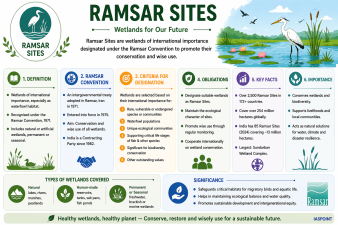
Ramsar sites are wetlands of international importance designated under the Ramsar Convention on Wetlands, an intergovernmental treaty adopted on February 2, 1971, in the Iranian city of Ramsar. India became a contracting party to the convention on February 1, 1982.
- Current Status (2026): India hosts 98 Ramsar sites, covering a total area of approximately 13,60,805 hectares.
- Significance: February 2 is celebrated globally as World Wetlands Day.
- Definition of Wetland: Under the convention, wetlands include areas of marsh, fen, peatland, or water, whether natural or artificial, permanent or temporary, with water that is static or flowing, fresh, brackish, or salt, including areas of marine water the depth of which at low tide does not exceed six meters.
The Montreux Record
The Montreux Record is a register of wetland sites on the List of Ramsar sites where changes in ecological character have occurred, are occurring, or are likely to occur as a result of technological developments, pollution, or other human interference.
- Current Indian Sites in Montreux Record: * Keoladeo National Park (Rajasthan)
- Loktak Lake (Manipur)
- Removed Sites: Chilika Lake (Odisha) was placed on the record in 1993 but removed in 2002 following successful restoration, making it the first site in Asia to be removed from the list.
Distribution and State-wise Statistics
India’s Ramsar sites are distributed across diverse geographical zones, from the high-altitude lakes of Ladakh to the mangroves of West Bengal.
| Category | Record Holder | Location |
| State with most sites | Tamil Nadu | 20 Sites |
| State with 2nd most sites | Uttar Pradesh | 11 Sites |
| Largest Ramsar Site | Sundarban Wetland | West Bengal |
| Smallest Ramsar Site | Renuka Wetland | Himachal Pradesh |
Recent Inscriptions (2024-2025)
India has rapidly expanded its Ramsar network, adding several sites to reach the current tally of 98. Notable recent additions include:
- Bihar: Nagi Bird Sanctuary, Nakti Bird Sanctuary, and Gogabeel Lake.
- Karnataka: Aghanashini Estuary, Magadi Kere Conservation Reserve, and Ankasamudra Bird Conservation Reserve.
- Madhya Pradesh: Tawa Reservoir.
- Rajasthan: Khichan Wetland (famous for Demoiselle Cranes) and Menar Wetland Complex.
360° View of Key Ramsar Sites
High Altitude Wetlands
- Tso Kar & Tsomoriri (Ladakh): Critical breeding grounds for the Black-necked Crane.
- Chandra Taal (Himachal Pradesh): A high-altitude lake in the Spiti Valley.
Unique Ecosystems
- Keibul Lamjao (Loktak Lake, Manipur): The only floating national park in the world, characterized by phumdis (floating islands of vegetation).
- Gulf of Mannar (Tamil Nadu): A marine biosphere reserve and Ramsar site known for Dugongs (Sea Cows).
- Lonar Lake (Maharashtra): A unique saline, alkaline crater lake formed by a meteorite impact.
Urban and Man-made Wetlands
- East Kolkata Wetlands (West Bengal): Famous for being a natural “sewage treatment plant” for the city.
- Bhoj Wetland (Madhya Pradesh): Consists of two man-made lakes (Upper and Lower Lake) providing water to Bhopal.
Criteria for Designation
To be classified as a Ramsar site, a wetland must meet at least one of nine criteria, which include:
- Supporting vulnerable, endangered, or critically endangered species.
- Regularly supporting 20,000 or more waterbirds.
- Being a significant source of food for fishes, spawning grounds, or nursery.
- Regularly supporting 1% of the individuals in a population of one species or subspecies of wetland-dependent non-avian animal species.
Conservation Trivia for UPSC
- Ramsar Bureau: The secretariat of the convention is located in Gland, Switzerland, shared with the IUCN.
- World’s First Ramsar Site: The Cobourg Peninsula in Australia (1974).
- Country with Most Sites: The United Kingdom (175 sites).
- Global Area Coverage: Bolivia has the largest area under Ramsar protection globally.
- Wetlands (Conservation and Management) Rules, 2017: The domestic legal framework in India that prohibits activities like conversion to non-wetland use, reclamation, and setting up of industries within designated wetlands.