
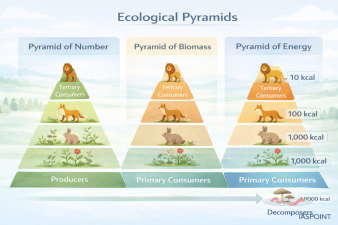
An Ecological Pyramid is a graphical representation designed to show the relationship between different trophic levels in an ecosystem. It illustrates the biomass, energy, or number of organisms at each level. The concept was first introduced by Charles Elton in 1927, hence they are often called Eltonian Pyramids. The base of the pyramid is always represented by the Producers (First Trophic Level), while the apex is formed by the Top Carnivores (Tertiary or Quaternary Consumers).
1. Pyramid of Numbers
This pyramid represents the total number of individual organisms at each trophic level. Depending on the ecosystem, it can be upright, partly upright, or completely inverted.
- Upright Pyramid of Numbers: Common in Grassland and Pond ecosystems. The number of producers (grass/phytoplankton) is significantly higher than the number of top predators (hawks/large fish).
- Inverted Pyramid of Numbers: Observed in a Parasitic Food Chain. For example, a single tree (producer) supports many herbivorous birds, which in turn support an even larger number of parasites (lice/bugs).
- Spindle-Shaped Pyramid: Seen in forest ecosystems where a few large trees support many birds, which are then consumed by a few hawks.
2. Pyramid of Biomass
This pyramid represents the total dry weight (biomass) of all organisms at each trophic level at a particular time. It provides a more accurate representation of the standing crop than the pyramid of numbers.
- Upright Pyramid of Biomass: Found in most Terrestrial Ecosystems. The biomass of plants is much greater than the biomass of herbivores and carnivores (e.g., Forests, Grasslands).
- Inverted Pyramid of Biomass: Characteristic of Aquatic Ecosystems (Lakes and Oceans).
- Reason: The producers (phytoplankton) have a very high turnover rate and short life span. Although they reproduce quickly, their “standing crop” at any given moment is less than the biomass of the fish that consume them.
3. Pyramid of Energy
This pyramid represents the total amount of energy utilized at each trophic level per unit area and time. It is the most fundamental of all ecological pyramids.
- Shape: It is ALWAYS upright. It can never be inverted.
- Scientific Basis: This follows the Second Law of Thermodynamics and Lindeman’s 10% Law. As energy flows from one level to the next, a significant portion (approx. 90%) is lost as heat during respiration and metabolic activities.
- Significance: It reflects the actual functional role of trophic levels and explains why food chains are limited to 4–5 levels.
Comparison Table: Ecological Pyramids
| Type of Pyramid | Parameter Measured | Can it be Inverted? | Ecosystem Example |
| Number | Individual Count | Yes | Upright (Grassland); Inverted (Parasitic) |
| Biomass | Dry Weight (Living Matter) | Yes | Upright (Forest); Inverted (Aquatic/Pond) |
| Energy | Energy Flow (kcal/m2/yr) | No | Always Upright (Universal) |
Limitations of Ecological Pyramids
While useful, ecological pyramids have certain scientific drawbacks often tested in UPSC:
- Species Complexity: They do not take into account the same species belonging to two or more trophic levels (e.g., humans or sparrows).
- Food Webs: They assume a simple food chain, whereas in nature, complex food webs exist.
- Decomposers: Saprotrophs and decomposers are usually not given any place in ecological pyramids, despite their vital role in nutrient cycling.
- Storage: They do not account for the rate of accumulation of biomass or energy, only the “standing crop” at a specific moment.
Key Trivia for UPSC Prelims
- Biomass Measurement: Dry weight is preferred over fresh weight because water content varies seasonally and does not represent actual organic matter.
- Ecological Efficiency: This refers to the efficiency with which energy is transferred. In the Pyramid of Energy, the efficiency is strictly around 10%.
- Accumulation vs. Flow: The Pyramid of Numbers and Biomass describe the “Standing State,” whereas the Pyramid of Energy describes the “Rate of Flow.”