
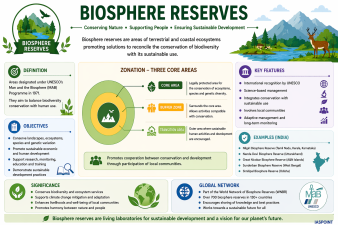
Biosphere Reserves (BRs) are international designations created by UNESCO for representative parts of natural and cultural landscapes extending over large areas of terrestrial or coastal/marine ecosystems. They are intended to be “learning places for sustainable development” where conservation of biodiversity is balanced with its sustainable use.
The UNESCO Man and the Biosphere (MAB) Programme
Launched in 1971, the MAB Programme is an intergovernmental scientific program that aims to establish a scientific basis for the improvement of relationships between people and their environments.
- World Network of Biosphere Reserves (WNBR): This is a global network where certain national biosphere reserves are recognized internationally. While all BRs in India are notified by the Central Government, only a subset is included in the WNBR.
- Legal Status in India: Unlike National Parks and Sanctuaries, the term “Biosphere Reserve” is not defined under the Wildlife (Protection) Act, 1972. They are established through administrative decrees.
Zonation of a Biosphere Reserve
A Biosphere Reserve is organized into three interrelated zones to fulfill complementary functions of conservation and sustainable development.
Core Area
- Definition: A strictly protected ecosystem that contributes to the conservation of landscapes, ecosystems, species, and genetic variation.
- Permitted Activities: Only non-destructive research and monitoring are allowed. It must be a protected area under the Wildlife (Protection) Act (e.g., a National Park or Sanctuary).
Buffer Zone
- Definition: The zone surrounding or adjoining the core area.
- Permitted Activities: Activities compatible with sound ecological practices, including environmental education, recreation, eco-tourism, and applied research.
Transition Area (Area of Cooperation)
- Definition: The outermost part of the reserve where the greatest activity is allowed.
- Permitted Activities: Settlements, cropping, managed forests, and other economic uses. In this zone, local communities, management agencies, and scientists work together to manage and sustainably develop the area’s resources.
Functions of Biosphere Reserves
Biosphere Reserves serve three primary functions:
- Conservation: To ensure the conservation of landscapes, ecosystems, species, and genetic variations.
- Development: To foster economic and human development which is socio-culturally and ecologically sustainable.
- Logistic Support: To provide support for research, monitoring, education, and information exchange related to local, national, and global issues of conservation and development.
Biosphere Reserves in India
India has established 18 Biosphere Reserves. Out of these, 12 are currently part of the UNESCO World Network of Biosphere Reserves (WNBR).
| Biosphere Reserve | Location (State) | Included in WNBR? | Key Fauna/Trivia |
| Nilgiri | TN, Kerala, Karnataka | Yes (2000) | First BR in India; Nilgiri Tahr, Lion-tailed Macaque. |
| Gulf of Mannar | Tamil Nadu | Yes (2001) | Marine BR; Dugong (Sea Cow). |
| Sundarbans | West Bengal | Yes (2001) | Royal Bengal Tiger; largest mangrove forest. |
| Nanda Devi | Uttarakhand | Yes (2004) | Snow Leopard, Himalayan Black Bear. |
| Nokrek | Meghalaya | Yes (2009) | Red Panda; part of the Garo Hills. |
| Pachmarhi | Madhya Pradesh | Yes (2009) | Giant Squirrel, Flying Squirrel. |
| Similipal | Odisha | Yes (2009) | Gaur, Royal Bengal Tiger, Wild Elephant. |
| Achanakmar-Amarkantak | MP, Chhattisgarh | Yes (2012) | Source of Narmada, Johilla, and Son rivers. |
| Great Nicobar | Andaman & Nicobar | Yes (2013) | Saltwater Crocodile, Giant Robber Crab. |
| Agasthyamala | Kerala, Tamil Nadu | Yes (2016) | High medicinal plant diversity. |
| Khangchendzonga | Sikkim | Yes (2018) | India’s first “Mixed World Heritage Site.” |
| Panna | Madhya Pradesh | Yes (2020) | Critical Tiger habitat; Ken-Betwa river link project. |
| Cold Desert | Himachal Pradesh | No | Pin Valley NP and Chandertal. |
| Kachchh | Gujarat | No | Largest BR in India; Indian Wild Ass. |
| Manas | Assam | No | Golden Langur, Red Panda. |
| Dibru-Saikhowa | Assam | No | Smallest BR in India; Feral Horses. |
| Seshachalam Hills | Andhra Pradesh | No | Famous for Red Sanders. |
| Dihang-Dibang | Arunachal Pradesh | No | Mishmi Takin, Musk Deer. |
Comparative Trivia for Prelims
- Largest Biosphere Reserve: Kachchh, Gujarat (Total area).
- Smallest Biosphere Reserve: Dibru-Saikhowa, Assam.
- Latest Addition to WNBR: Panna Biosphere Reserve (2020).
- Geographical Distribution: The Nilgiri Biosphere Reserve is a “tri-junction” reserve, spanning across three southern states.
- Ecosystem Diversity: India’s BRs cover various biomes including Cold Deserts (Himachal), Hot Deserts (Gujarat), Rainforests (Northeast), and Marine ecosystems (Gulf of Mannar).