
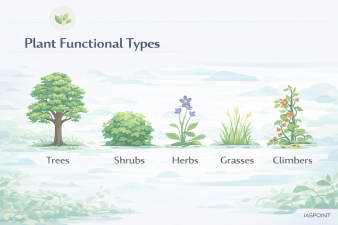
Plant Functional Types (PFTs) are groupings of plant species that share similar physiological, morphological, and responses to environmental factors, regardless of their taxonomic (evolutionary) relationship. This classification is used in climate modeling and ecology to predict how ecosystems react to environmental changes like global warming or deforestation.
- Basis of Classification: Life form (tree, shrub, herb), leaf longevity (evergreen vs. deciduous), leaf type (broadleaf vs. needleleaf), and photosynthetic pathway (C3, C4, CAM).
- Significance: PFTs simplify the vast diversity of plants into manageable categories to study carbon sequestration, water cycles, and energy exchange between the land and atmosphere.
Primary PFT Categories based on Leaf Morphology and Phenology
This is the most common classification used by organizations like the IPCC and the ISRO (for National Carbon Project mapping).
| Functional Type | Key Characteristics | Indian Examples |
|---|---|---|
| Broadleaf Evergreen | Leaves remain year-round; found in high-rainfall zones. | Mesua ferrea (Nagkesar), Rosewood. |
| Broadleaf Deciduous | Shed leaves seasonally (usually in dry summer). | Teak (Tectona grandis), Sal (Shorea robusta). |
| Needleleaf Evergreen | Coniferous; adapted to cold and nutrient-poor soils. | Deodar, Blue Pine (Pinus wallichiana). |
| Needleleaf Deciduous | Rare; shed needles in winter. | Larch (found in parts of Eastern Himalayas). |
| Sclerophyllous | Hard, leathery leaves to reduce water loss. | Olive, certain scrub oaks in the Himalayas. |
Classification by Photosynthetic Pathways
Plants are categorized based on how they fix carbon dioxide during photosynthesis. This is a recurring theme in UPSC Prelims.
1. C3 Plants
- Mechanism: The first stable product is a 3-carbon compound (3-PGA).
- Efficiency: Less efficient in high temperatures due to photorespiration.
- Examples: Rice, Wheat, Soybeans, and most trees.
- Trivia: C3 plants benefit more from “Carbon Fertilization” (increased atmospheric CO2) than C4 plants.
2. C4 Plants
- Mechanism: The first stable product is a 4-carbon compound (Oxaloacetic acid). They use “Kranz Anatomy” to minimize photorespiration.
- Efficiency: Highly efficient in high temperatures and low water conditions.
- Examples: Maize, Sugarcane, Millets (Bajra, Jowar), and many tropical grasses.
3. CAM (Crassulacean Acid Metabolism) Plants
- Mechanism: Stomata open at night to fix CO2 and close during the day to prevent water loss.
- Environment: Desert and extremely arid regions.
- Examples: Cacti, Pineapple, Agave, and many Orchids (epiphytes).
Classification by Life History Strategies (Grime’s C-S-R Triangle)
Ecologist J.P. Grime proposed that plants adopt one of three strategies to survive based on stress and disturbance.
- Competitors (C): Thrive in low-stress, low-disturbance environments (e.g., giant rainforest trees). They allocate resources to rapid growth.
- Stress-Tolerators (S): Adapted to high-stress, low-disturbance environments (e.g., alpine plants, desert succulents). They grow slowly and conserve resources.
- Ruderals (R): Found in low-stress, high-disturbance environments (e.g., weeds like Parthenium or grasses in floodplains). They reproduce quickly and produce many seeds.
Functional Types based on Water Requirement
- Hydrophytes: Aquatic plants; may be submerged (Hydrilla), floating (Lotus), or emergent (Typha).
- Mesophytes: Terrestrial plants requiring moderate water (most agricultural crops).
- Xerophytes: Adapted to water scarcity through succulents, deep roots, or reduced leaves (Khejri, Opuntia).
- Hygrophytes: Plants that require high moisture but are not fully aquatic (Ferns in tropical rainforest floors).
Key UPSC Facts
- Phyto-remediation Types: Some plants are categorized as Hyperaccumulators (e.g., Pteris vittata for Arsenic). They are a functional type used to clean up heavy metal pollution in soil.
- Nitrogen Fixers: A functional group (mostly Legumes like Peas, Beans, and Alfalfa) that forms a symbiotic relationship with Rhizobium bacteria to enrich soil nitrogen.
- Pioneer Species: A functional type (e.g., Lichens, Mosses, or grasses like Saccharum) that are the first to colonize barren land after a disturbance like a volcanic eruption or landslide.