

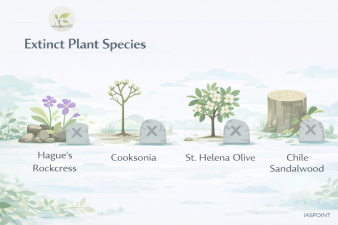
Extinction refers to the complete disappearance of a plant species from its natural habitat and cultivation. According to the IUCN (International Union for Conservation of Nature), a species is declared Extinct (EX) when there is no reasonable doubt that the last individual has died after exhaustive surveys in known and expected habitats.
- Extinct in the Wild (EW): The species survives only in captivity, cultivation, or as a naturalized population well outside its past range (e.g., in Botanical Gardens).
- Pseudo-extinction: When a species evolves into a new species, and the ancestor is no longer found.
- Lazarus Species: A species that was thought to be extinct but is later rediscovered in the wild (e.g., the recent rediscovery of several orchid species in the Northeast).
Status of Extinct Flora in India
The Botanical Survey of India (BSI) monitors the status of Indian flora. While India is a megadiverse country, habitat loss and climate change have led to the presumed extinction of several species.
| Species Name | Region / Habitat | Category | Trivia / Facts |
| Limnophila limnophiloides | North-East India | Extinct (EX) | Recently added to the extinct list (2024-25). It was an aquatic herb. |
| Sterculia khasiana | Meghalaya (Khasi Hills) | Extinct (EX) | Not sighted in the wild for over 70 years; victims of habitat fragmentation. |
| Lastreopsis wattii | Manipur | Extinct (EX) | A rare fern species from the Eastern Himalayas. |
| Corypha taliera | Bengal / Myanmar | Extinct in Wild (EW) | A giant palm. It exists only in cultivation (e.g., in the AJC Bose Indian Botanic Garden). |
| Hubbardia heptaneuron | Western Ghats (Jog Falls) | Extinct (EX) | A unique grass species that grew in the spray zone of waterfalls; lost due to hydroelectric projects. |
| Madhuca insignis | Karnataka / Kerala | Extinct (EX) | A wild relative of Mahua. Some recent reports suggest rediscovery, but still listed as EX/CR. |
Major Causes of Plant Extinction in India
The extinction of plant species is rarely the result of a single factor but rather a combination of anthropogenic and natural pressures.
1. Habitat Destruction and Fragmentation
The conversion of forests into agricultural land, highways, and urban centers. When a habitat is fragmented, the “edge effect” alters the micro-climate, making it unsuitable for specialized endemic plants.
2. Invasive Alien Species (IAS)
Species like Lantana camara and Prosopis juliflora create monocultures, physically and chemically (via allelopathy) preventing native species from regenerating, leading to localized extinctions.
3. Over-Exploitation
Plants with high medicinal or commercial value are often harvested beyond their reproductive capacity. Examples include Himalayan Yew (Source of Taxol) and Red Sanders.
4. Climate Change
Shifts in rainfall patterns and temperature affect high-altitude alpine flora. As temperatures rise, these plants have no higher ground to migrate to, leading to “mountain-top extinction.”
5. Co-extinction
Many plants rely on specific pollinators (bees, birds, bats). If the pollinator goes extinct due to pesticides or habitat loss, the plant species eventually follows.
Legal and Institutional Safeguards
- Biological Diversity Act, 2002: Section 38 empowers the Central Government to notify species that are on the verge of extinction and prohibit their collection.
- Red Data Book of Indian Plants: Published by the BSI, this document tracks the status of threatened and extinct Indian flora.
- The “Zero Extinction” Target: Part of the Kunming-Montreal Global Biodiversity Framework, which India is a signatory to, aiming to halt human-induced extinction of known threatened species by 2030.
Important Facts for Prelims
- Centres of Extinction: The Western Ghats and Eastern Himalayas have the highest number of extinct and threatened species due to high endemism.
- The 50-Year Rule: Historically, a species was considered extinct if not seen for 50 years, but the IUCN now requires “exhaustive surveys” regardless of the time frame.
- Botanical Lazarus: Begonia tessaricarpa, a plant from Arunachal Pradesh, was rediscovered after 150 years in 2021, highlighting the importance of continuous field surveys.
- Seed Vaults as Insurance: Facilities like the Chang La Vault and Svalbard are specifically designed to prevent “functional extinction” of crop varieties.