
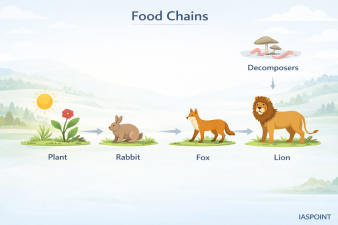
A Food Chain is a linear sequence of organisms through which nutrients and energy pass as one organism eats another. It identifies the feeding relationship between species within an ecosystem.
Types of Food Chains
Ecologists categorize food chains into two primary types based on the source of energy at the first trophic level.
1. Grazing Food Chain (GFC)
The Grazing Food Chain begins with green plants (producers) at the base. It is the most common food chain in both terrestrial and aquatic ecosystems where sunlight is the primary energy source.
- Terrestrial GFC: Grass → Grasshopper → Frog → Snake → Hawk.
- Aquatic GFC: Phytoplankton → Zooplankton → Small Fish → Large Fish.
2. Detritus Food Chain (DFC)
The Detritus Food Chain begins with dead organic matter (detritus), such as fallen leaves or animal carcasses. It is powered by decomposers and detritivores.
- Sequence: Detritus (Dead leaves) → Earthworm → Frog → Snake.
- Significance: In terrestrial ecosystems, a much larger fraction of energy flows through the DFC than the GFC. It is the primary mechanism for nutrient recycling.
Key Characteristics of Food Chains
- Unidirectional Flow: Energy moves in only one direction. It cannot be recycled back to the previous level (e.g., energy from a herbivore cannot return to a producer).
- Length Limitation: Most food chains consist of only 3 to 5 levels. Due to the 10% Law of Energy Transfer, energy becomes insufficient to support a population at higher levels.
- Dominance in Ecosystems: In aquatic ecosystems, GFC is the major conduit for energy flow. In terrestrial ecosystems, DFC is often more dominant in terms of total energy processed.
Food Web: The Network of Chains
In nature, linear food chains are rare. Multiple food chains intersect to form a Food Web.
- Stability: A food web increases ecosystem stability. If one species in a chain declines, consumers have alternative food sources.
- Interconnectivity: An organism may occupy different trophic levels in different food chains simultaneously (e.g., a sparrow is a primary consumer when eating seeds, but a secondary consumer when eating insects).
Important Concepts for UPSC Prelims
Comparison: GFC vs. DFC
| Feature | Grazing Food Chain (GFC) | Detritus Food Chain (DFC) |
| Start Point | Living green plants (Autotrophs) | Dead organic matter (Detritus) |
| Energy Source | Solar radiation | Organic waste/Decay |
| Primary Level | Photosynthetic organisms | Saprotrophs/Detritivores |
| Dominance | High in Aquatic systems | High in Terrestrial systems |
Ecological Efficiency
Ecological efficiency is the percentage of energy transferred from one trophic level to the next. It is generally low, averaging around 10%. This explains why the “Biomass” of top predators is significantly lower than that of producers.
Impact of Pollutants
- Bioaccumulation: The buildup of a persistent toxin within a single organism’s body over its lifetime.
- Biomagnification: The progressive increase in toxin concentration at each successive trophic level. High-level predators in a food chain are the most vulnerable (e.g., Diclofenac’s impact on Vultures).
Trophic Levels and Species Roles
- Keystone Species: A species that has a disproportionately large effect on its natural environment relative to its abundance (e.g., Sea Otters in Kelp forests). Their removal can cause a food chain collapse.
- Indicator Species: Species whose presence, absence, or abundance reflects a specific environmental condition (e.g., Lichens for air quality).
- Apex Predators: Organisms at the top of the food chain with no natural predators (e.g., Bengal Tiger).